Times Software
Digital Marketing Agency
Digital Marketing Agency
Why Businesses Are Exploring Happy Manager for Team Management
Managing a team today is very different from simply assigning tasks, checking deadlines, and reviewing results. Employees want clarity, managers need practical tools, and organizations are increasingly aware that productivity cannot be separated completely from communication, motivation, development, and workplace well-being. This is one reason businesses and management professionals are exploring resources such as The Happy Manager, a management-focused platform designed around practical ideas, tools, and insights for managers at different levels. Its current Knowledge Hub covers subjects including teams, leadership, workplace well-being, motivation, decision-making, problem-solving, managing performance, goal setting, and project management.
The attraction is not simply the word “happy.” The bigger idea is that effective management requires balance. A manager needs enough knowledge to understand a situation, enough practical skill to act on that knowledge, and enough awareness of people and well-being to recognize how decisions affect the team. The Happy Manager describes this through its “head, hand and heart” approach: the head represents management knowledge and insight, the hand represents practical management skills and action, and the heart represents well-being. For businesses trying to create productive teams without turning the workplace into a pressure cooker, that combination can be an appealing way to think about management.
Table of Contents
ToggleThe phrase Happy Manager can refer to different organizations and services, so context matters. The focus of this article is The Happy Manager, the management resource platform associated with Phil Higson and Professor Anthony Sturgess. The site says it was created in 2007 and has served managers, trainers, students, and educators with management resources, practical tools, articles, and guides. Rather than presenting management as a single formula that every organization must follow, its material explores different aspects of management and encourages readers to connect ideas with real workplace situations.
That approach is particularly relevant for businesses because team management rarely follows a neat textbook pattern. Imagine a manager dealing with an employee who is technically excellent but struggling with motivation. Another employee may be highly enthusiastic but need better organization. A third person might perform well independently but create communication problems when working with colleagues. These situations require different responses, and a manager who relies only on authority or one-size-fits-all policies can quickly find that the same management technique produces completely different outcomes for different people.
The Happy Manager's current material is built around the idea that managers need resources that help them think, act, and develop. The platform describes its content as a combination of ideas, techniques, tools, tips, stories, and evidence-informed management guidance, with an emphasis on workplace well-being. That makes it especially interesting for organizations looking for management development material rather than simply another software dashboard. It is less about pressing a button to “manage employees” and more about improving the human decisions behind everyday management.
The head, hand, and heart concept is one of the clearest reasons businesses may find the Happy Manager philosophy useful. The “head” asks whether a manager understands the situation and has enough knowledge to make a sound decision. The “hand” asks whether the manager can translate that knowledge into practical action. The “heart” asks whether the manager understands motivation, well-being, and the human consequences of management decisions.
Consider a simple example. A manager notices that a project is consistently missing deadlines. The head might examine workload, processes, dependencies, and priorities. The hand might involve changing responsibilities, improving planning, removing bottlenecks, or introducing a clearer review process. The heart might involve asking whether employees are overwhelmed, confused, disengaged, or simply working toward goals they do not understand. Looking at all three dimensions produces a much richer response than simply telling everyone to “work harder.”
Balance matters because organizations are made of people, processes, technology, customers, and competing priorities. Focusing entirely on performance can create short-term output while damaging morale. Focusing entirely on employee comfort can create an environment where difficult decisions are avoided. Effective management sits between these extremes, creating conditions in which people understand what needs to happen, have the capability to do it, and can sustain their performance over time.
This balanced philosophy also helps explain why workplace well-being appears alongside subjects such as leadership, performance, decision-making, and project management within The Happy Manager's Knowledge Hub. Well-being is not presented as a replacement for performance; instead, it is connected to the broader question of how managers can create healthier and more productive workplaces. That distinction is important for businesses because employee happiness without direction is not enough, while performance without sustainable working conditions can eventually become expensive and difficult to maintain.
Traditional management often depended on hierarchy. A manager gave instructions, employees followed them, and success was measured largely through output. That model can still work in certain environments, but modern teams are often more distributed, specialized, collaborative, and knowledge-driven. Employees may work across departments, locations, time zones, or projects, making communication and coordination just as important as formal authority.
Managers therefore have to become facilitators as well as supervisors. They need to create clarity without micromanaging, encourage accountability without creating unnecessary fear, and provide feedback without turning every conversation into a performance judgment. The Happy Manager's focus on teams, leadership, motivation, performance, and personal development fits naturally into this changing environment. Its current team resources include discussions around workload distribution, teamwork, flexible workplaces, problem-solving, and managing former peers.
The challenge is that modern management has more moving parts. A team might include experienced specialists, new graduates, remote employees, contractors, and people working on multiple projects simultaneously. Managers need to understand individual differences while still creating common goals. Resources that encourage managers to think about team dynamics rather than simply individual tasks can therefore become useful learning tools.
Command-and-control management treats the manager as the center of every decision. That may create the appearance of control, but it can also make teams dependent on one person. If employees need managerial approval for every small issue, work slows down and employees have fewer opportunities to develop judgment. A stronger approach is to create clear boundaries within which people can make appropriate decisions themselves.
This is where good team management becomes less like controlling traffic and more like designing a road system. A good road system provides signs, rules, lanes, and destinations, but drivers still make many decisions themselves. Similarly, managers need to provide expectations, priorities, resources, and feedback while allowing employees enough autonomy to contribute. The Happy Manager's emphasis on leadership, team development, decision-making, problem-solving, and practical management skills provides useful themes for developing that type of environment.
Leadership is not simply a more impressive word for management. Management often focuses on planning, organizing, coordinating, and achieving objectives, while leadership adds direction, influence, purpose, and the ability to bring people with you. A team can have an excellent task manager and still lack a sense of shared purpose. Conversely, a charismatic leader without organizational discipline can inspire people while failing to deliver consistent results.
The Happy Manager connects leadership with practical management rather than treating the two as completely separate subjects. Its material argues that developing leadership includes learning from examples, understanding teams, and releasing team potential. It also presents its STAR team performance model, which connects individual strengths, teamwork, alignment, and results. For businesses, this is an important perspective because a high-performing team is rarely created simply by hiring talented individuals.
Communication is one of the first areas where team management either succeeds or breaks down. A manager may believe that expectations are obvious while employees are interpreting priorities completely differently. Small misunderstandings then become missed deadlines, duplicated work, unnecessary meetings, and frustration.
Better communication begins with clarity. What is the goal? Who owns the task? What does successful completion look like? Which decisions can employees make independently? When should a problem be escalated? These questions may sound basic, but answering them consistently can remove a surprising amount of workplace friction.
Managers also need to listen. Communication is not a one-way pipeline in which information travels from manager to employee. It is more like a feedback loop. Employees see operational problems that senior leaders may never encounter directly, so creating opportunities for honest feedback can help managers identify risks earlier. A team that feels comfortable raising problems is often easier to manage than a team that remains silent until a small issue becomes a major crisis.
Workplace well-being is another major part of the Happy Manager approach. Its material describes the “heart” of management as understanding the importance of well-being both inside and outside the workplace. That perspective is valuable because managers frequently influence employee experience through everyday decisions involving workload, priorities, communication, recognition, flexibility, and expectations.
Well-being does not mean eliminating pressure or making every workday effortless. Challenging projects can be meaningful and motivating. The real question is whether pressure is manageable, whether people understand what is expected, whether they have appropriate support, and whether success is possible without continuously sacrificing health and personal life.
For businesses, this can have a practical implication. Managers should not wait until an employee reaches complete exhaustion before discussing workload. Regular conversations about priorities, capacity, obstacles, and development can make problems easier to identify while they are still manageable. A happy manager is therefore not necessarily someone who smiles constantly; it is someone who understands that sustainable performance depends partly on creating healthy conditions for work.
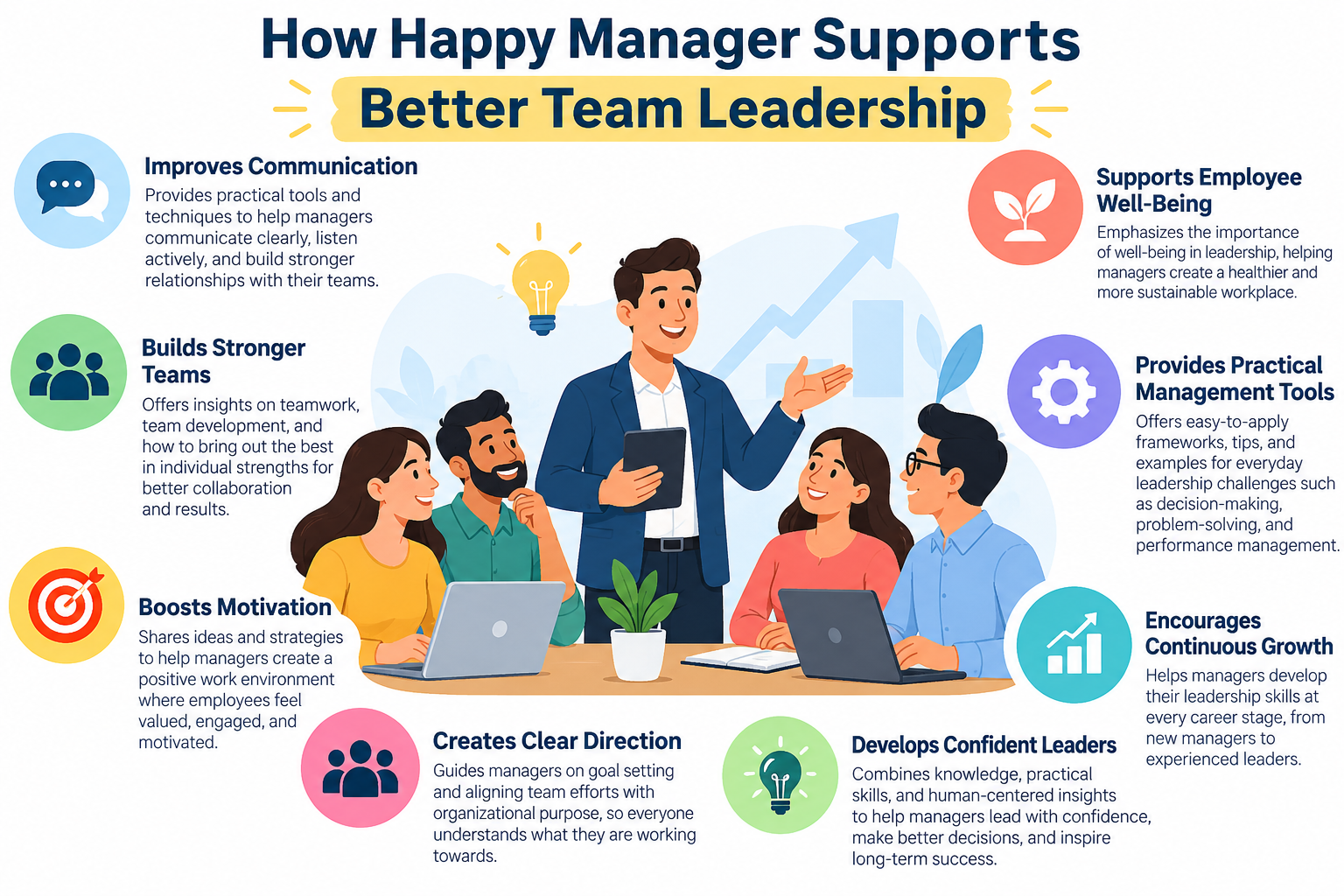
Motivation is often misunderstood as something managers simply “give” employees. In reality, motivation is influenced by many factors, including meaningful work, autonomy, recognition, progress, relationships, competence, fairness, and the connection between individual effort and organizational goals. The Happy Manager dedicates significant attention to workplace motivation and links motivation with well-being and performance.
Imagine two employees receiving the exact same assignment. One sees it as an opportunity to develop a valuable skill, contribute to an important project, and gain recognition. The other sees it as another repetitive task with no visible purpose. Their technical ability may be identical, but their level of engagement can be very different. Managers who understand this difference are better positioned to create roles and working environments where employees can see why their contributions matter.
Meaning is powerful because people generally want to understand the purpose behind their effort. If a manager says, “Complete this report by Friday,” the employee knows what to do but may not understand why it matters. If the manager explains that the report will help the sales team identify customer trends and make better decisions, the same task suddenly has context.
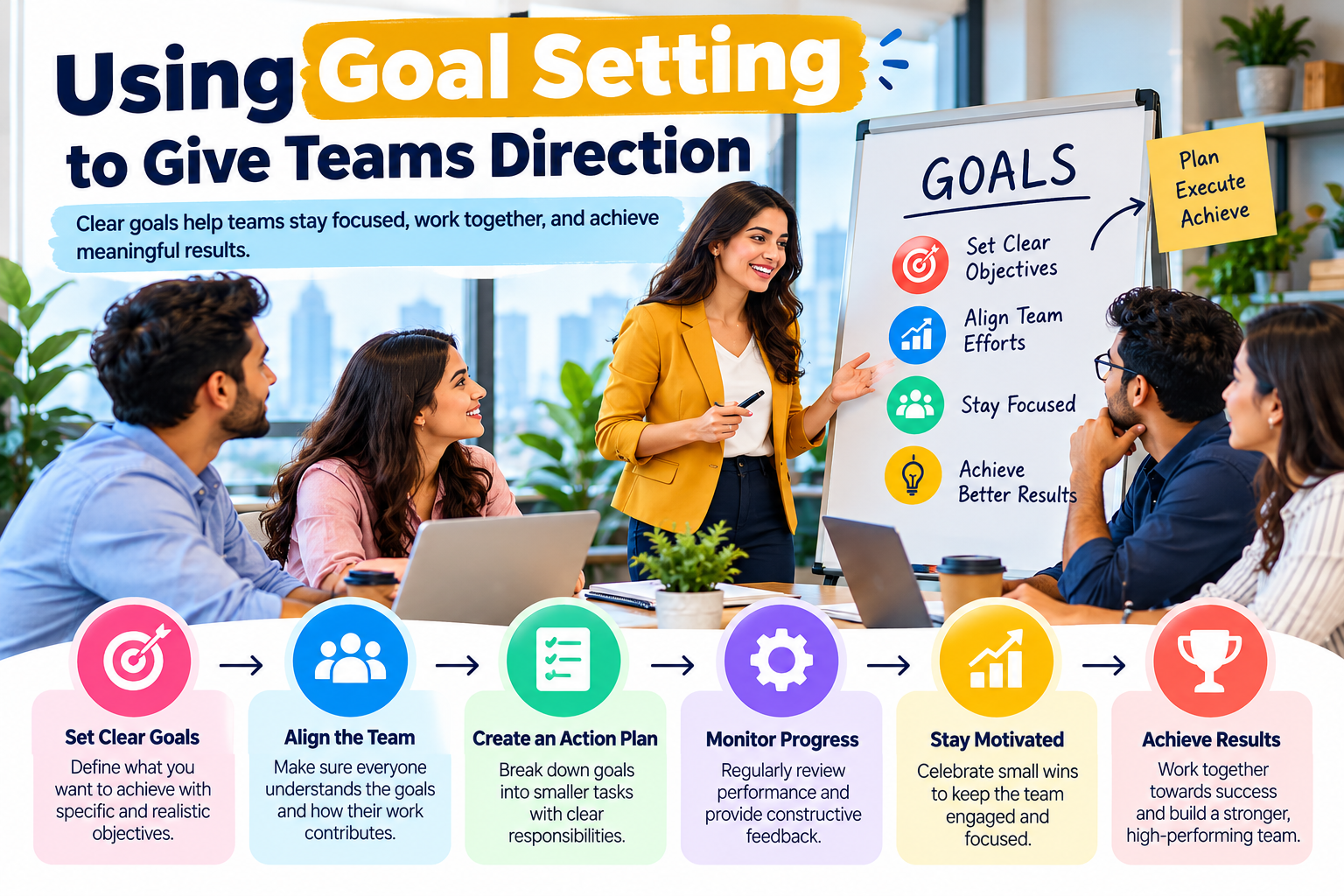
Goal setting can help create this connection. Clear goals show employees where the team is going, while meaningful explanations show why the destination matters. The Happy Manager's resources cover motivation, goal setting, and producing meaningful results, reflecting this connection between individual work and broader organizational value.
Recognition also matters. It does not always have to mean financial rewards. A manager might recognize thoughtful problem-solving, reliable teamwork, improvement, mentoring, or taking responsibility during a difficult situation. When recognition is specific rather than generic, employees can understand which behaviors the organization values.
One reason businesses explore management resource platforms is simple: managers encounter practical problems every day. An employee misses a deadline. Two colleagues disagree. A project changes direction. A customer complaint escalates. A new team member needs support. Senior leadership introduces a new target. None of these situations comes with a convenient instruction manual.
The Happy Manager provides resources covering decision-making, problem-solving, managing performance, goal setting, time management, projects and change, and personal development. These areas are useful because they turn management from an abstract leadership discussion into something managers can practice.
Good managers do not simply make decisions quickly; they make appropriate decisions at the right level. Some decisions should remain with the manager because they involve significant risk or organizational responsibility. Other decisions should be delegated so employees can build confidence and ownership.
Problem-solving follows a similar principle. A manager who immediately fixes every problem may appear helpful, but the team can become dependent on that manager. A better approach may sometimes be to guide employees through the problem: What exactly is happening? What caused it? What options exist? What are the risks? Which solution is most practical? What should be tested first?
The Happy Manager has long emphasized structured approaches to problem-solving and decision-making, including practical models designed to help managers move from identifying a problem toward analysis, possible solutions, implementation, and evaluation. The value of such tools is not that they eliminate judgment, but that they give managers a framework for using judgment more consistently.
A team without clear goals can look busy while moving in different directions. People attend meetings, answer messages, complete tasks, and generate reports, yet the overall result may remain disappointing because individual activity is not aligned with the organization's priorities.
Goal setting acts like a compass. It does not eliminate obstacles, but it gives the team a reference point when priorities compete. A useful goal should make the desired outcome understandable and give employees enough clarity to determine what deserves attention.
The Happy Manager's resources include material on goal setting and business planning, including its structured F-Plan approach. Its strategy material also emphasizes purpose, perspective, and process as useful ways of thinking about strategy. These ideas are valuable because a goal should not exist in isolation. Managers need to connect objectives with organizational purpose and then translate broad strategy into actions employees can actually perform.
For example, saying “increase customer satisfaction” is directionally useful but incomplete. A team may need to know which customers, which part of the experience, what timeframe, which measures, and what behaviors will contribute to improvement. Clear goals reduce ambiguity and make performance conversations much more constructive.
Strong teams are not simply collections of strong individuals. A group can contain ten talented people and still perform poorly if responsibilities overlap, communication is weak, trust is low, or individual strengths are not coordinated. Team development therefore requires managers to look at how people work together, not just how each person performs separately.
The Happy Manager's team-performance material specifically explores the connection between individual strengths, teamwork, alignment, and results through its STAR model. The underlying idea is highly practical: managers should understand what individuals bring to the team and then create conditions in which those strengths contribute to a shared outcome.
Suppose one employee is excellent at analysis, another is naturally strong at communication, and another is highly organized. If everyone is asked to perform the same type of work regardless of their strengths, some potential may remain unused. But when responsibilities are designed intelligently, the team can become greater than the sum of its parts.
This does not mean putting people permanently into narrow boxes. Employees should have opportunities to develop new capabilities, and managers should avoid stereotyping people based on a single strength. Instead, the goal is to understand where people currently perform well while creating opportunities for growth.
Managers can encourage this through collaborative projects, peer learning, mentoring, cross-training, and shared problem-solving. Development becomes part of everyday work rather than something that happens only during an annual performance review.
Understanding Adorb.co: Products, Shopping Options, and More
A Complete Guide to Custom Printing Services From PrintSafari.com INC
How oukitel Phones Combine Battery Life, Performance, and Durability
Top Benefits of Buying Responsibly Sourced Meat Through Crowd Cow
Key Facts You Should Know About C Telekom Inc Before Choosing Its Services
A new manager and a senior manager may face completely different problems, but both need opportunities to learn. A first-time manager may struggle with delegation, difficult conversations, and setting boundaries. A middle manager may need to coordinate several teams while translating senior leadership priorities into operational plans. A senior manager may be dealing with organizational change, strategy, culture, and long-term leadership development.
The Happy Manager explicitly positions its resources for managers who are junior, middle, senior, experienced, new, or aspiring, as well as educators and students. That broad audience makes sense because management development is not something that should stop after a person receives a promotion.
In fact, promotion can expose a person to an entirely new set of challenges. A technically brilliant employee may become a manager because of excellent individual performance, only to discover that managing people requires a different skill set. Technical expertise remains valuable, but managers also need communication, delegation, coaching, decision-making, conflict management, planning, and emotional awareness.
Businesses that invest in management development can therefore create a stronger leadership pipeline. Instead of waiting for problems to appear, they can help managers build skills before responsibilities become overwhelming.
There is a difference between knowing that good management matters and knowing what to do on Monday morning. A leadership book may explain a compelling theory, but managers often need something more immediate: questions to ask, steps to follow, frameworks to test, or examples that help translate theory into action.
This practical orientation is one of the distinguishing features of The Happy Manager. Its site describes its resources as ideas, tips, techniques, tools, stories, and practical guidance, and it offers e-guides containing management and leadership material. That makes the platform potentially useful as a supplementary resource for managers, trainers, educators, and organizations designing development programs.
The key word is supplementary. No online management resource can replace an organization's own policies, professional HR advice, leadership judgment, employee consultation, or understanding of its specific legal and operational environment. A framework is a starting point, not a magic wand. The best results come when managers adapt useful ideas to the realities of their teams.
The future of management is unlikely to be purely technological or purely human. Businesses will continue adopting project-management systems, analytics platforms, artificial intelligence, collaboration tools, and automation. At the same time, employees will still need managers who can explain priorities, resolve disagreements, develop talent, make decisions, and create healthy working relationships.
That is why the head, hand, and heart model remains interesting. Technology can provide information, but managers still need to interpret that information. Automation can complete tasks, but leaders still need to decide which tasks should be automated and how changes affect employees. Data can reveal performance patterns, but it cannot automatically replace the human conversation required to understand why those patterns exist.
Current discussions on The Happy Manager also show an ongoing interest in modern team issues such as flexible workplaces, workload distribution, former-peer management, team development, and field-service problem-solving. This suggests that effective management is not a static discipline. As work changes, managers need to keep learning and adapting.
Businesses exploring Happy Manager should therefore see it as part of a broader management-development ecosystem. Its value is strongest when managers use the ideas as prompts for reflection and action: What is happening in our team? What are we trying to achieve? What is getting in the way? How are people experiencing the work? Which management behavior should change? What result would demonstrate improvement?
Businesses are exploring Happy Manager for team management because effective management increasingly requires more than task allocation and performance monitoring. Managers need practical skills, sound knowledge, strong communication, meaningful goals, problem-solving ability, leadership capability, and an understanding of employee well-being. The Happy Manager brings these themes together through a philosophy centered on the balance of head, hand, and heart, while providing resources across teams, leadership, motivation, performance, decision-making, goal setting, and workplace well-being.
The biggest lesson is that a “happy manager” is not simply a cheerful manager. It is a manager who understands that sustainable performance depends on both results and people. A strong manager knows when to direct, when to delegate, when to listen, when to challenge, and when to support. They create clarity without unnecessary control and accountability without destroying trust.
For businesses, this approach can be especially useful as teams become more flexible, distributed, specialized, and collaborative. The goal is not to make management easier by pretending workplace challenges do not exist. The goal is to equip managers with better ways to understand those challenges and respond to them intelligently. When knowledge, practical action, leadership, motivation, and well-being work together, team management becomes less about simply getting people to work and more about creating the conditions in which people can do meaningful work well.
The Happy Manager is a management resource platform offering ideas, tools, articles, guides, and practical insights for managers, educators, and students. Its current resources cover areas such as leadership, teams, workplace well-being, motivation, performance management, decision-making, problem-solving, goal setting, and project management.
The head represents management knowledge and understanding, the hand represents practical management skills and action, and the heart represents workplace well-being and the human side of management. The approach suggests that effective management requires all three rather than relying exclusively on knowledge, action, or employee-focused thinking.
It can provide managers with frameworks and ideas for thinking about teamwork, communication, team development, motivation, and performance. Its material includes a STAR team-performance model that connects individual strengths, teamwork, alignment, and results.
Employee well-being can influence how sustainably people perform at work. The Happy Manager places well-being at the center of its “heart” concept and treats it as an important part of effective management rather than as a completely separate HR issue.
Not necessarily. The Happy Manager discussed in this article is primarily a management learning and resource platform, not a replacement for an organization’s HR systems, payroll software, project-management tools, or formal policies. Its strongest role is as a source of management knowledge, practical frameworks, reflection, and professional development.



times.software
Table of Contents
×