
Times Software
Digital Marketing Agency
Digital Marketing Agency
How oukitel Phones Combine Battery Life, Performance, and Durability
Discover how oukitel phones combine powerful battery life, reliable performance, and rugged durability. Explore their key features, battery capacities, processors, outdoor capabilities, and why oukitel smartphones are designed for users who need dependable performance in demanding environments.
Table of Contents
ToggleOUKITEL has developed a recognizable position in the smartphone market by putting battery capacity, rugged construction, and practical performance at the center of many of its devices. Instead of treating a smartphone simply as a thin glass-and-metal communication device, the company’s rugged lineup is designed around the idea that a phone may need to survive demanding environments while remaining useful for work, travel, entertainment, and communication. Its rugged-phone range includes models such as the WP35, WP35 Pro, WP300, WP100 Titan, and WP500, with battery capacities ranging from around 10,000mAh in some models to an impressive 33,000mAh in the WP100 Titan. This range shows that OUKITEL does not follow a single formula for every buyer; instead, it offers different combinations of portability, battery endurance, processing power, and rugged features. The result is a category of phones aimed at people who may prioritize reliability and endurance over an ultra-thin design. Think of the approach like building an all-terrain vehicle rather than a city car: the goal is not merely to look sleek but to keep working when conditions become rough. That philosophy becomes especially visible when examining how OUKITEL combines a large battery with processors capable of supporting modern applications, generous memory configurations, and protection against water, dust, drops, and difficult environmental conditions. For consumers who spend long periods away from charging points or work outdoors, that combination can be more meaningful than focusing on a single specification. A large battery without useful performance would feel like carrying extra weight, while a fast processor inside a fragile phone could be impractical for demanding environments. OUKITEL’s design strategy attempts to bring these elements together into a single device category.
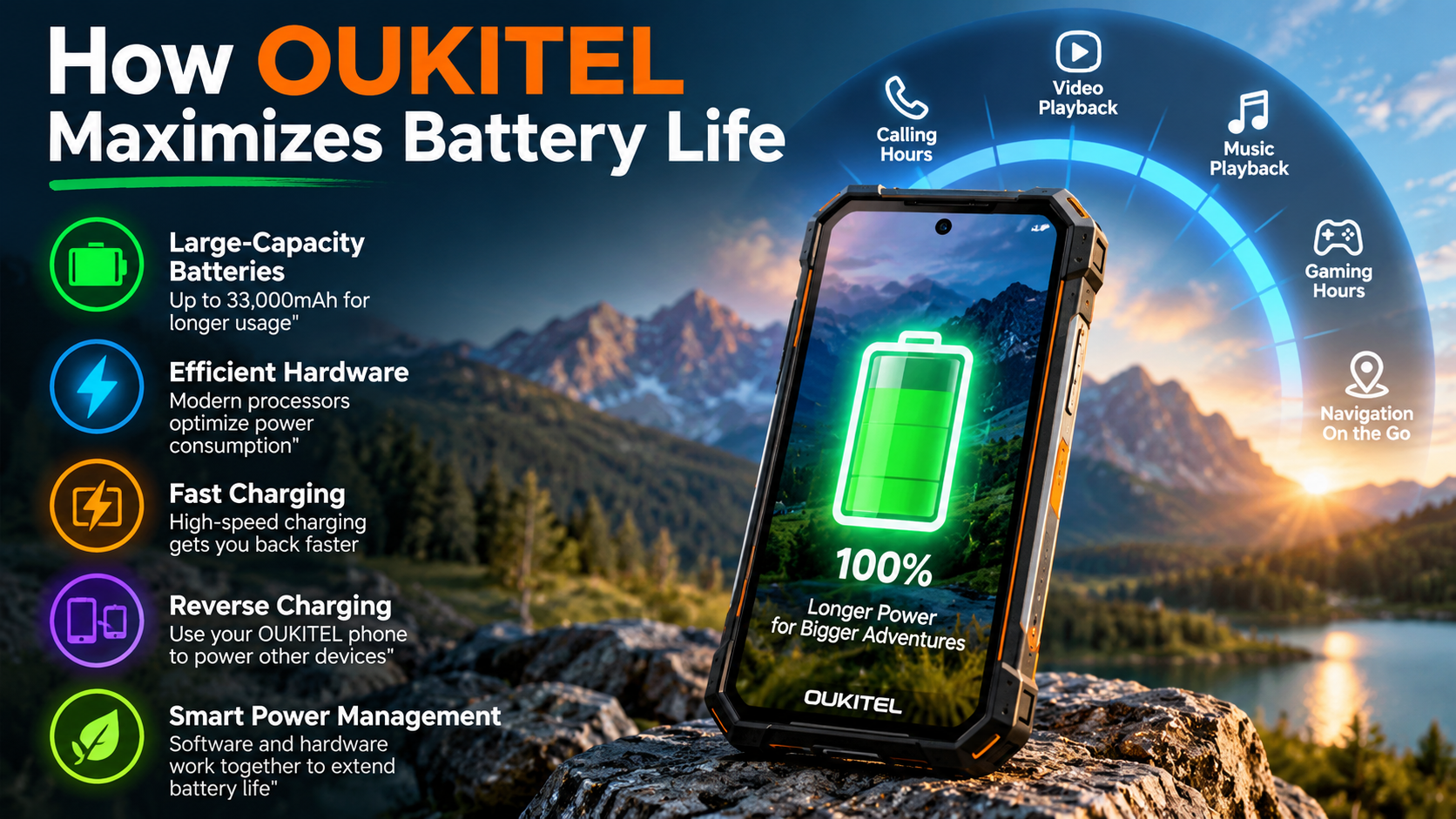
Battery life is one of the most obvious areas where OUKITEL phones differentiate themselves. Conventional smartphones often focus on keeping the body thin and lightweight, which places practical limits on how much battery capacity can be included. OUKITEL’s rugged models take a different approach by accepting a larger and heavier chassis when that allows significantly more battery capacity. Some models feature 10,000mAh or 11,000mAh batteries, while the WP300 reaches 16,000mAh and the WP100 Titan goes as high as 33,000mAh. This capacity can be valuable when the phone is being used for navigation, photography, communication, streaming, hotspot access, or fieldwork away from a wall outlet. It also changes how users think about charging. Instead of constantly watching a battery percentage throughout the day, a high-capacity phone can provide a larger buffer for unpredictable usage. Of course, battery capacity is not the same thing as guaranteed real-world battery duration because screen brightness, network conditions, processor workload, applications, temperature, and signal strength all influence consumption. A huge battery should therefore be understood as additional energy capacity rather than an automatic promise of a particular number of days. Still, for travelers, outdoor workers, drivers, campers, construction professionals, and other users who may spend extended periods away from conventional charging, that extra capacity can make a substantial practical difference.
Battery endurance becomes much more useful when it is paired with hardware capable of handling modern smartphone workloads. OUKITEL’s newer rugged phones increasingly use MediaTek processors rather than relying exclusively on entry-level chipsets. The WP100 Titan, for example, uses the MediaTek Dimensity 7300, an octa-core processor manufactured on a 4nm process. The company lists the processor with four Cortex-A78 performance cores and four Cortex-A55 efficiency cores. Other OUKITEL models use processors such as the Dimensity 6300, Dimensity 6100+, and Dimensity 8300. These differences matter because rugged phones are not necessarily purchased only for making calls or checking messages. A modern user may expect to switch between navigation, email, social media, video, photography, cloud applications, productivity tools, and entertainment without the phone feeling overwhelmed. Processor architecture, memory, storage speed, thermal management, and software optimization all contribute to that experience. The key idea is balance: performance should be strong enough for the phone's intended workload without undermining battery endurance. OUKITEL’s approach is particularly interesting because its large batteries give the company more room to support capable hardware while still targeting long operating periods. In practical terms, the performance story is less about having the fastest phone in every benchmark and more about making a rugged phone feel like a modern smartphone rather than a specialized survival gadget.
OUKITEL’s battery strategy is based primarily on capacity, but capacity is only one part of the equation. The company combines large batteries with charging systems intended to reduce the inconvenience of carrying a high-capacity power source inside the phone. The WP100 Titan provides a particularly dramatic example with its 33,000mAh battery, 66W charging, and 18W reverse charging. The manufacturer also publishes long estimated usage figures for activities such as calling, music playback, video playback, and gaming under its stated test conditions. These figures should not be interpreted as universal real-world guarantees because actual results vary with network coverage, display settings, applications, temperature, and usage patterns. What they do demonstrate is the scale of the battery system being used. The same principle can be seen throughout OUKITEL’s rugged range, where 10,000mAh and 11,000mAh batteries appear frequently. A larger battery can also be useful for people who use their phone as an emergency power source for other devices, provided the model supports reverse charging. In the case of the WP100 Titan, 18W reverse charging means the phone can function as a substantial power bank for compatible accessories or another phone. This creates a different relationship with battery life: instead of the smartphone being merely another device that needs electricity, it can become part of a small portable power system.
The most visible feature of OUKITEL’s rugged phones is often the battery itself. The WP35 and WP35 Pro, for example, are built around 11,000mAh batteries, while the WP100 Titan moves dramatically higher to 33,000mAh. This kind of capacity is particularly relevant for scenarios where access to electricity is uncertain. Imagine spending a full day hiking through an area with limited facilities, working at a remote site, traveling through regions where charging opportunities are irregular, or using GPS continuously during a long journey. In those situations, battery anxiety can become a genuine inconvenience because the phone may be needed for safety, navigation, communication, and documentation at the same time. A high-capacity battery provides additional breathing room. The trade-off is physical size and weight, and OUKITEL does not hide that compromise. The WP100 Titan, for instance, is substantially larger and heavier than a typical mainstream smartphone because it houses the enormous battery and additional rugged hardware. That is dramatically different from the design philosophy of a conventional flagship smartphone, so this type of device is not designed around the idea that lighter is always better. Instead, OUKITEL treats battery capacity as a physical resource worth carrying when endurance is a priority. For the right user, that trade can make sense. For someone who primarily wants a lightweight phone for social media and casual messaging, a huge battery may provide benefits that do not justify the added bulk. The real advantage appears when endurance is a requirement rather than simply a nice-to-have feature.
A huge battery introduces a natural question: How long does it take to recharge? OUKITEL addresses this through fast-charging support on several rugged models. The WP100 Titan, for example, supports 66W charging and 18W reverse charging. While charging a battery as large as 33,000mAh naturally takes longer than charging a conventional smartphone, faster charging reduces the amount of time required to refill that large energy reserve. The purpose of fast charging in a device like this is not necessarily to make a massive battery charge instantly; it is to reduce downtime relative to the battery's enormous capacity. Reverse charging adds another layer of flexibility. If a companion device runs out of power during a trip, the OUKITEL phone can potentially provide energy to it instead of becoming only a consumer of electricity. That can be especially practical for wireless accessories, secondary phones, lights, or other compatible devices. The usefulness of reverse charging depends on the connected device and charging requirements, so it should not be treated as a replacement for a dedicated power bank in every situation. Still, the feature reinforces OUKITEL’s broader philosophy: battery capacity should provide practical utility beyond simply keeping the phone switched on. When battery, charging, and reverse charging are considered together, the phone becomes closer to a portable energy hub than a conventional smartphone.
A rugged phone does not need to sacrifice modern performance simply because it is designed to survive difficult environments. OUKITEL’s current products show a movement toward hardware that can handle ordinary smartphone tasks while also supporting specialized outdoor functions. The WP100 Titan combines the Dimensity 7300 with 16GB of physical RAM and 512GB of storage, while memory expansion can provide additional virtual memory. The WP35 Pro provides 12GB RAM and 512GB storage alongside the Dimensity 6300. Storage matters more than it may initially appear because rugged-phone users may rely heavily on offline maps, photographs, videos, documents, downloaded entertainment, and work files while traveling. Similarly, sufficient RAM can help when switching among several applications. This does not mean every user needs 16GB or additional virtual memory, and virtual RAM should not be confused with physical RAM because the two use resources differently. Instead, these configurations show that OUKITEL is trying to position some rugged phones as full-featured smartphones rather than basic emergency devices. The performance balance is also important for battery efficiency. A newer, more efficient processor can potentially deliver stronger performance without requiring the same power draw as an older design under comparable workloads. Ultimately, the best configuration depends on what the user actually does. Someone who mainly makes calls may never notice the difference, while a person using navigation, photography, video, productivity apps, and demanding software throughout the day may appreciate the additional headroom.
The processors used in OUKITEL’s recent rugged phones illustrate how the company is connecting durability with contemporary smartphone capabilities. The WP100 Titan uses the MediaTek Dimensity 7300, which includes an octa-core design with Cortex-A78 and Cortex-A55 cores and is manufactured using a 4nm process. The WP35 Pro uses the Dimensity 6300 on a 6nm process, while the WP35 uses the Dimensity 6100+. Some newer OUKITEL models also use higher-performance chipsets. These processors are aimed at different performance levels, meaning buyers should not assume every OUKITEL phone performs identically simply because they belong to the rugged category. The processor influences application responsiveness, graphics capabilities, camera processing, connectivity features, and power consumption. For users who want a rugged phone that still feels like a modern Android device, choosing the appropriate chipset is therefore important. A model equipped with a stronger processor can be better suited to multitasking and demanding applications, whereas a more modest chipset may make more sense for basic communication and long battery endurance. OUKITEL’s range gives consumers room to make that trade-off. This is useful because rugged phones have historically been associated with sacrificing mainstream smartphone features in exchange for toughness. As processors become more capable and efficient, that compromise becomes less severe. A phone can be built like a piece of outdoor equipment while still offering the computational power needed for contemporary applications.
RAM and storage play a supporting role in the balance between performance and practicality. The WP100 Titan is available with 16GB of physical RAM and 512GB of storage, while its software-based memory expansion can increase the advertised memory figure. The WP35 Pro offers 12GB RAM and 512GB storage, giving users a substantial amount of space for applications and files. Large storage is particularly helpful on a rugged device because its target audience may capture large numbers of photos and videos outdoors, store offline navigation data, keep work documents locally, or download entertainment for travel. At the same time, RAM helps Android maintain applications in memory and supports smoother transitions between tasks, although the benefit depends on the software and workload. It is also important to separate marketing numbers from technical reality: virtual RAM typically uses internal storage as an extension and does not deliver exactly the same performance characteristics as physical memory. Nevertheless, having ample storage and a reasonable amount of RAM can make a device feel less restrictive over time. The practical question for a buyer is simple: What will you actually store and run? If the answer includes navigation, video, photography, work applications, communication tools, streaming, and games, additional storage and capable hardware can become genuinely useful. If the phone is mainly used for calls and occasional messaging, an extremely high memory configuration may be unnecessary. OUKITEL’s range gives users the ability to choose according to their workload instead of assuming that every rugged phone needs identical hardware.
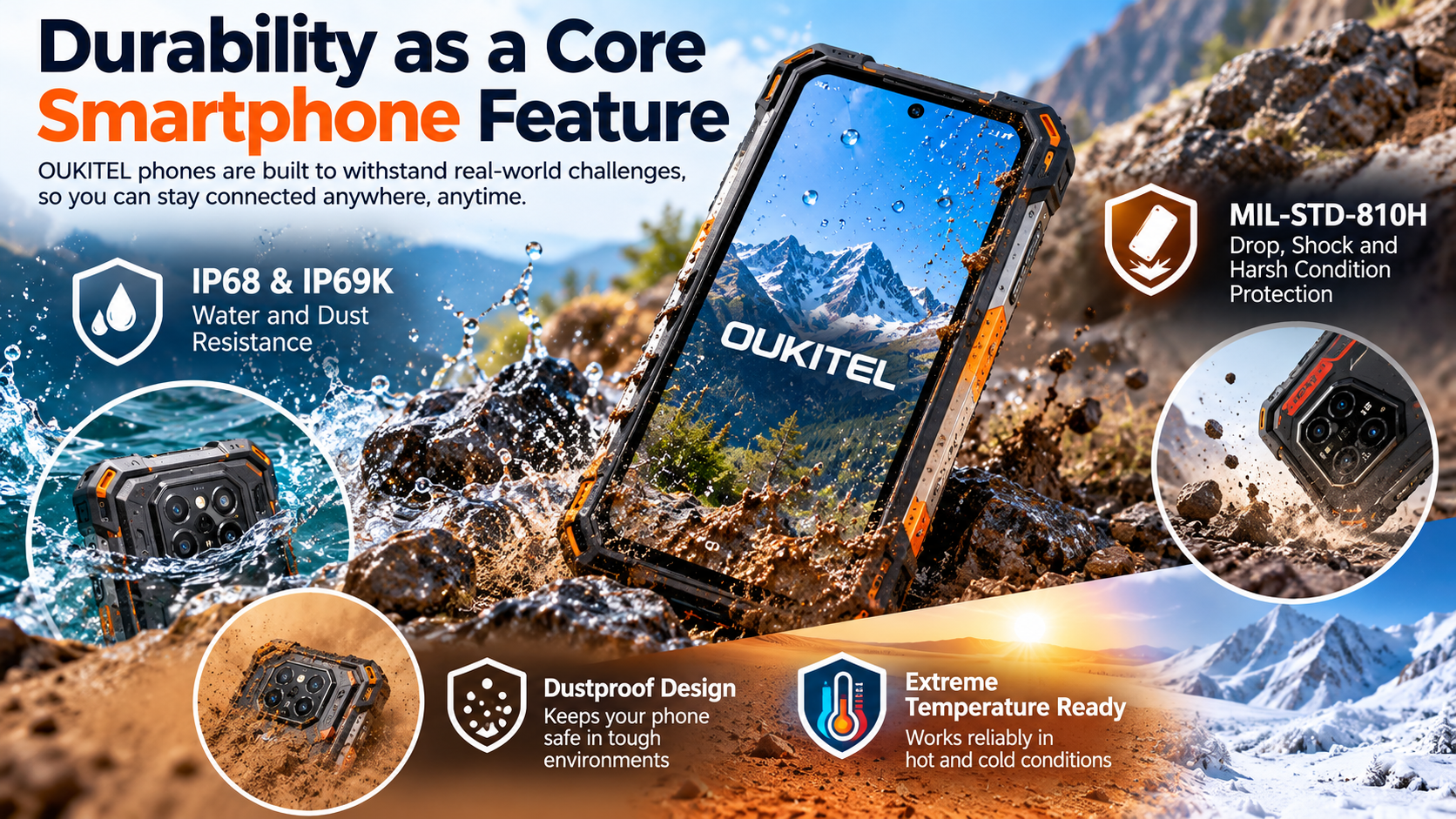
Durability is where OUKITEL’s rugged-phone identity becomes especially clear. Rather than simply adding a larger battery to a conventional smartphone, the company's rugged devices are engineered around resistance to environmental hazards. Many rugged models feature protection standards such as IP68, IP69K, and MIL-STD-810H, depending on the specific device. These ratings address different aspects of protection and should not be interpreted as meaning that a phone is indestructible. IP ratings concern protection against solids and water under defined test conditions, while MIL-STD-810H refers to military-standard environmental testing procedures that can involve different stresses depending on the specific test methods used. The WP100 Titan, for example, carries IP68 and IP69K protection and is marketed with MIL-STD-810H durability. That combination is designed to make the phone more suitable for environments where an ordinary consumer smartphone may be exposed to greater physical or environmental risk. Think of the difference between wearing everyday shoes and wearing work boots: both allow you to walk, but one is designed with more challenging conditions in mind. Rugged construction can be valuable for construction sites, outdoor recreation, industrial environments, fieldwork, logistics, travel, and other situations where drops, dust, water, and temperature changes are realistic possibilities.
IP protection is an important part of OUKITEL's rugged design philosophy. The WP100 Titan, for example, is rated IP68 and IP69K. IP68 generally concerns protection against dust and water immersion under specified testing conditions, while IP69K is associated with resistance to powerful high-temperature water jets under defined laboratory conditions. These designations are meaningful because they provide standardized information about environmental protection. The important word in both cases is specified. Certification does not mean that every possible type of liquid, depth, pressure, temperature, or exposure is automatically safe. Users should follow the manufacturer's care instructions and understand that seals can age or become compromised through physical damage, repairs, or normal wear. Still, these ratings provide a useful layer of confidence for people who regularly work or travel in wet or dusty environments. A rugged phone that can tolerate environmental exposure is particularly valuable when it is being used for navigation or communication in places where replacing a damaged device would be difficult. The combination of IP protection with a reinforced physical structure creates a broader defense strategy than simply adding a water-resistant coating. It is one of the reasons OUKITEL's rugged phones are positioned differently from ordinary smartphones. Durability is not a secondary accessory feature; it is part of the core product concept.
Military-standard testing is another component of OUKITEL's durability strategy. The WP100 Titan is marketed as MIL-STD-810H rated, alongside its IP68 and IP69K protection. This should be interpreted carefully because MIL-STD-810H is a collection of environmental engineering and laboratory test methods rather than a single universal “indestructibility” test. Different devices can undergo different subsets of tests, so consumers should examine the manufacturer's documentation if a particular environmental condition is especially important. For everyday users, however, the broader message is straightforward: the phone is designed with harsh conditions in mind. Rugged construction generally involves reinforced frames, protective materials, sealed ports, raised edges, strengthened corners, and protective glass. The WP100 Titan also uses Corning Gorilla Glass 5 over its large display. This combination is useful because durability is rarely about one feature. A phone could have excellent water resistance but still be vulnerable to a hard impact, while a thick case might protect against drops but leave openings vulnerable to dust or water. OUKITEL's rugged design attempts to address several risks simultaneously. That makes these phones particularly relevant to users who consider accidental damage a recurring possibility rather than an unlikely event. The trade-off, again, is size and weight. Rugged protection generally requires more material, and OUKITEL embraces that rather than trying to make every model resemble an ultra-thin flagship.
The OUKITEL WP100 Titan provides one of the clearest examples of how battery, performance, and durability can be combined in a single rugged phone. Its specifications include a 33,000mAh battery, Dimensity 7300 processor, 16GB RAM, 512GB storage, a 6.8-inch FHD+ 120Hz display, and 5G connectivity. It also features a 200MP main camera, 20MP night-vision camera, and 32MP front camera, showing that OUKITEL is not treating ruggedness as an excuse to eliminate modern smartphone functions. The device is considerably larger and heavier than a conventional mainstream smartphone, which makes its intended use case very different from that of a pocket-friendly flagship. Yet that size also creates room for the enormous battery and additional outdoor-oriented hardware. The WP100 Titan also includes specialized features such as a built-in projector and high-output camping light. This is an interesting example of product design built around field utility. Instead of asking, “How can we make this phone thinner?” the design asks, “What additional tools could make this phone useful when someone is away from conventional equipment?” The answer includes energy storage, lighting, projection, night vision, and rugged protection. It is therefore best understood as a specialized all-purpose outdoor device rather than simply a large smartphone.
The WP100 Titan's specifications demonstrate how aggressively OUKITEL has combined hardware components. The phone has a 33,000mAh battery, 66W charging, 18W reverse charging, Dimensity 7300 processing, 16GB RAM, and 512GB storage. Its display measures 6.8 inches diagonally, offers FHD+ resolution, and supports a 120Hz refresh rate. That 120Hz panel can make scrolling, animations, and compatible content feel smoother than a conventional 60Hz screen, although it can also consume more power depending on usage. The large battery provides considerable capacity to offset the energy demands of a large high-refresh-rate display and capable processor. The phone also supports modern connectivity features such as 5G, Wi-Fi, Bluetooth, NFC, and satellite navigation systems. This collection makes the device suitable for users who need connectivity as well as endurance. There is a certain logic to the configuration: if a phone is going to be carried into remote environments, it needs more than just a tough shell. It needs enough processing power to run modern applications, enough storage to retain useful files, and enough connectivity options to remain practical. The WP100 Titan's specifications therefore illustrate OUKITEL's broader design philosophy particularly well. The company is combining the characteristics of a smartphone, portable power source, and outdoor tool into one unusually large device.
One of the most interesting aspects of the WP100 Titan is that its large physical design is used for more than battery capacity. Product materials describe a built-in projector and a powerful camping light alongside its large battery and rugged construction. These features can make sense in outdoor or emergency scenarios where carrying several separate devices would be inconvenient. A camping light can provide illumination around a tent, work area, vehicle, or campsite, while a projector could be useful for presentations or entertainment when a larger screen is unavailable. The usefulness of such features naturally depends on the user's lifestyle, and they should not be mistaken for replacements for dedicated professional equipment. Their importance is that they expand the phone's role beyond communication. The enormous battery becomes a resource capable of powering multiple functions rather than simply keeping the display alive. This is where OUKITEL's combination of characteristics becomes particularly interesting. Durability allows the phone to enter environments where delicate electronics may be at greater risk, battery capacity allows it to remain useful for longer periods, and additional hardware gives users more reasons to carry it. It is a bit like carrying a Swiss Army knife instead of a single-purpose tool: not every function will be used every day, but the value comes from having several capabilities available when circumstances change. For campers, travelers, field workers, and adventure enthusiasts, that versatility can be an important part of the appeal.
Top Benefits of Buying Responsibly Sourced Meat Through Crowd Cow
Key Facts You Should Know About C Telekom Inc Before Choosing Its Services
How to Find the Best Theme Park Deals With Undercover Tourist
Everything Marketers Should Know About SocialDog, Inc. and Its Tools
How Liquid Web + Nexcess Can Support Growing Online Businesses
Looking across OUKITEL's rugged range makes it easier to see that there is no single definition of the ideal rugged phone. The WP35 uses an 11,000mAh battery and Dimensity 6100+ processor, while the WP35 Pro retains the 11,000mAh capacity but upgrades the processor to Dimensity 6300 and provides a larger memory configuration. The WP100 Titan takes the concept much further with a 33,000mAh battery and Dimensity 7300, while newer models such as the WP500 combine a 10,000mAh battery with a Dimensity 8300 processor and high-resolution camera hardware. This variety shows that buyers should evaluate the three major characteristics together. A phone with an enormous battery may be ideal for endurance but too heavy for everyday commuting, while a lighter rugged phone may provide a better balance for users who still want protection without carrying nearly a kilogram of hardware. Similarly, a powerful processor may appeal to users who prioritize demanding applications, while a less powerful chip could be perfectly adequate for calls, messaging, navigation, and basic productivity. Durability is also relative to the environment. Someone working around dust and water may care more about IP ratings, while a person frequently exposed to drops may focus more heavily on physical construction and standardized testing. The right choice therefore depends on the balance between how long the phone needs to run, what it needs to accomplish, and where it needs to survive.
OUKITEL Model | Battery | Processor | Key Hardware | Main Focus |
WP35 | 11,000mAh | MediaTek Dimensity 6100+ | FHD+ display | Rugged endurance |
WP35 Pro | 11,000mAh | MediaTek Dimensity 6300 | 12GB RAM, 512GB storage | Endurance and performance |
WP300 | 16,000mAh | Model-dependent | Large display, high-resolution camera | High-capacity outdoor use |
WP100 Titan | 33,000mAh | MediaTek Dimensity 7300 | 16GB RAM, 512GB storage, 120Hz display | Maximum battery and rugged features |
WP500 | 10,000mAh | MediaTek Dimensity 8300 | 120Hz display, high-resolution camera | Higher-performance rugged use |
OUKITEL phones make the most sense for people whose smartphone needs extend beyond ordinary indoor use. Outdoor workers, travelers, campers, hikers, drivers, field technicians, construction workers, logistics professionals, and adventure enthusiasts can potentially benefit from the combination of high battery capacity and rugged protection. A person who spends eight hours at a desk with a charger nearby may not need an 11,000mAh or 33,000mAh battery, but someone working remotely from a construction site may value the extra capacity considerably. The same applies to travelers who use GPS continuously or people who regularly move through areas where charging infrastructure is limited. Rugged protection can also be useful for people who have previously damaged phones through accidental drops, exposure to water, or dusty working conditions. The important thing is to match the device to the environment rather than buying solely because a specification looks impressive. A massive battery is valuable only if the additional weight is acceptable. A high-performance processor is useful only if the user runs workloads that can take advantage of it. A rugged certification is valuable when the phone will actually encounter the conditions it is designed to resist. In other words, OUKITEL's strongest advantage is not necessarily that every model is the best fit for every person; it is that the company's lineup gives buyers more options when durability and endurance are priorities. For the right environment, those priorities can matter far more than having the thinnest phone in the room.
Before purchasing an OUKITEL phone, buyers should look beyond the headline battery number and evaluate the entire package. Weight and dimensions should be near the top of the checklist because rugged phones can be substantially larger than conventional smartphones. The WP100 Titan, for example, is considerably heavier and thicker than a mainstream smartphone because of its huge battery and additional hardware. That is a significant trade-off for its endurance and rugged capabilities. Buyers should also examine the exact processor rather than assuming that all rugged OUKITEL phones offer the same performance. A Dimensity 7300, Dimensity 6300, Dimensity 6100+, and Dimensity 8300 represent different performance tiers, so the model number matters. Software version, update support, camera requirements, network compatibility, charging speed, display refresh rate, and storage capacity are also worth checking before making a decision. Durability ratings should be understood in their testing context rather than interpreted as a guarantee that nothing can damage the phone. Finally, buyers should consider whether specialized features such as a camping light, projector, night-vision camera, or reverse charging will actually be useful. The best purchase is the one where the specifications match the user's routine. If portability matters most, a smaller rugged model may make more sense; if maximum endurance is the priority, a much larger battery may justify the additional bulk.
OUKITEL's smartphone strategy is built around a simple but increasingly relevant idea: a smartphone should remain useful even when conditions are not ideal. Its rugged lineup combines large batteries with modern processors, substantial memory and storage configurations, water and dust protection, reinforced construction, and specialized outdoor features. Current models demonstrate how broad the range has become, from 11,000mAh phones such as the WP35 series to the enormous 33,000mAh WP100 Titan and performance-oriented models such as the WP500. The WP100 Titan particularly illustrates the philosophy by combining a 33,000mAh battery, Dimensity 7300 processor, 120Hz display, 5G, 512GB storage, 66W charging, IP68/IP69K protection, and rugged construction in one device. The compromise is equally clear: rugged construction and enormous battery capacity can make these phones considerably heavier and thicker than mainstream alternatives. That means OUKITEL is not simply competing on thinness or conventional flagship aesthetics. Instead, it is targeting users who see battery endurance, physical resilience, and practical outdoor capability as essential parts of the smartphone experience. For people who regularly work, travel, or explore in demanding environments, that combination can provide an alternative to conventional smartphone design. The central lesson is that battery life, performance, and durability do not have to exist as separate priorities. With the right hardware balance, they can reinforce one another and turn a smartphone into a more dependable tool for everyday life and challenging environments.
OUKITEL’s rugged phones focus heavily on large battery capacities, physical durability, and outdoor-oriented features. Depending on the model, users can find batteries ranging from around 10,000mAh to 33,000mAh, along with IP-rated protection and rugged construction. The trade-off is that many of these phones are larger and heavier than conventional smartphones.
The OUKITEL WP100 Titan stands out for its 33,000mAh battery. It also supports fast charging and reverse charging, making its battery useful not only for the phone itself but potentially for powering other compatible devices.
Several OUKITEL rugged models carry IP-rated protection. The WP100 Titan, for example, has IP68 and IP69K protection. However, water-resistance ratings apply under defined testing conditions, so users should follow the manufacturer’s instructions and avoid assuming that any liquid exposure is automatically safe.
Performance varies considerably between models because OUKITEL uses different processors across its lineup. The WP100 Titan uses the MediaTek Dimensity 7300, while other models use processors such as the Dimensity 6300, Dimensity 6100+, or Dimensity 8300. Buyers should therefore compare the processor, RAM, storage, and intended workload rather than judging the entire brand by one model.
It can be, particularly for people who value battery endurance and durability. However, the size and weight of some models can be considerably greater than those of mainstream smartphones. Buyers should consider portability alongside battery capacity, performance, and rugged features before choosing a particular model.





times.software
Table of Contents
×