Top Benefits of Buying Responsibly Sourced Meat Through Crowd Cow
Buying meat today can feel surprisingly complicated. Walk into a supermarket and you may see dozens of labels promising words such as grass-fed, pasture-raised, organic, natural, or sustainably sourced. But how much do you really know about the farm behind the package, how the animals were raised, or the practices used before that steak, burger, or chicken breast reached your refrigerator?
That question sits at the center of Crowd Cow’s business model. The company focuses on connecting customers with farms, ranches, fisheries, and other producers while providing information about where its products come from. Rather than treating meat as an anonymous commodity, the platform emphasizes producer information, sourcing details, and different farming practices.
For shoppers who care about food transparency, farming practices, animal welfare, sustainability, and premium quality, this approach can make the meat-buying process feel more understandable. Instead of simply choosing a package based on price and appearance, shoppers can explore the producer, production method, breed, cut, and other characteristics associated with the product.
So, what are the biggest benefits of buying responsibly sourced meat through Crowd Cow? Let’s explore the reasons shoppers may consider this type of purchasing model and what makes the experience different from simply picking a package from a supermarket shelf.
Understanding Crowd Cow and Its Sourcing Philosophy
Crowd Cow was established in Seattle in 2015 with a goal of changing how meat is sourced, sold, and consumed. Rather than relying exclusively on the traditional commodity model, the company works with farms and producers and provides information about the people and businesses responsible for its food. Its marketplace includes beef, pork, chicken, seafood, Wagyu products, and other specialty options.
The basic idea is easy to understand: the more information consumers have about their food, the more informed their purchasing decisions can become. Think of it like buying coffee where the package tells you not only that it is coffee, but also where the beans were grown, who produced them, and what methods were used. Crowd Cow applies a similar philosophy to meat by putting producer information and sourcing details closer to the shopping decision.
This does not mean every product has exactly the same farming system. In fact, one interesting feature of Crowd Cow's marketplace is that products can come from different farms, regions, and countries and may use different production practices. Some beef is 100% grass-fed, while other products may be pasture-raised and grain-finished. The important point is that shoppers can examine the individual product instead of assuming that every item follows an identical production model.
From Commodity Meat to Producer Transparency
Traditional meat shopping often hides the journey between farm and dinner table. You may know the retailer and product category, but not necessarily the individual farm or producer. Crowd Cow's model attempts to shorten that informational distance by identifying producers and providing additional sourcing details.
This type of transparency can make the shopping process more personal. Imagine buying a steak and knowing not only the cut and weight but also the ranch or producer behind it. Suddenly, the product has a story. You have more information to evaluate before placing an order.
Crowd Cow provides producer-specific information that can include details about farming methods, animal breeds, geographic location, and other characteristics. This can be particularly useful for shoppers who want to compare products based on how the meat was produced, rather than relying only on price or appearance.
How Crowd Cow Connects Customers With Farms
Crowd Cow acts as a bridge between consumers and producers. The company works with independent farms, ranches, cooperatives, fisheries, and other producers and provides them with access to customers who might otherwise have difficulty discovering their products.
For a smaller producer, reaching consumers across a large geographic area can be challenging. Marketing, customer service, packaging, cold-chain logistics, and fulfillment require infrastructure that an individual farm may not want to build alone. A marketplace model can help bring those products to a larger audience.
This creates an interesting relationship between the shopper and the supply chain. A customer is not simply purchasing a steak; the purchase can also contribute to demand for a particular producer's products. For consumers interested in supporting smaller farms, that connection can be an important part of the overall shopping experience.
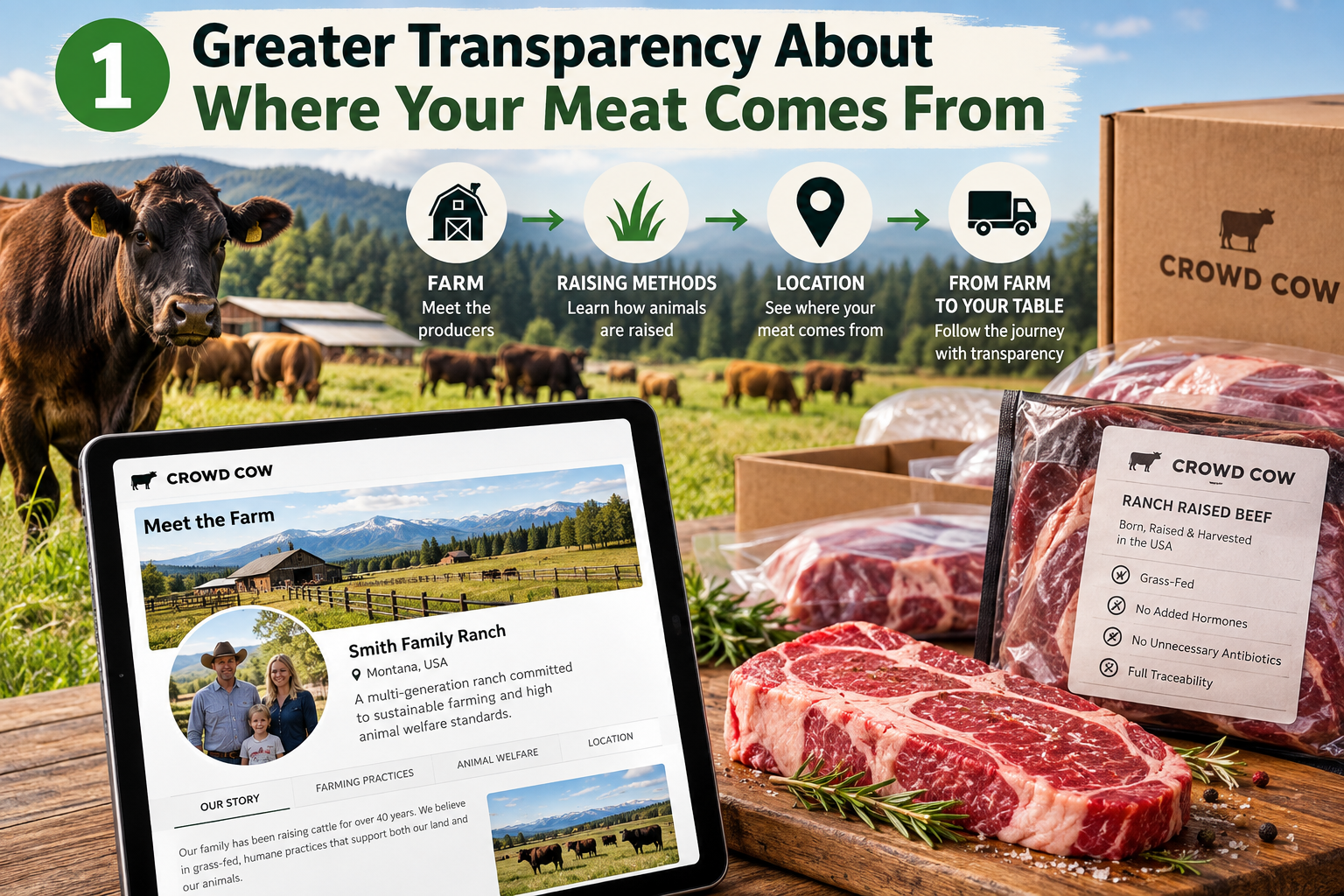
1. Greater Transparency About Where Your Meat Comes From
One of the clearest benefits of using Crowd Cow is the emphasis on traceability and producer information. Customers can explore information about the farm or producer associated with individual products, giving them a better understanding of where their food originated.
This matters because transparency changes the shopping experience. Imagine buying a steak and knowing not only the cut and weight but also the ranch or producer behind it. Suddenly, the product has a story. You can consider factors such as farming practices, breed, region, and production methods before making your purchase.
This is particularly valuable for people who have become more conscious of food supply chains. When a product gives you more information, you have greater control over your purchasing decision.
The difference is similar to buying vegetables at a farmers' market. You may not know every detail about the farming process, but you can often speak directly with the person who grew the food. Crowd Cow attempts to bring some of that producer connection into an online meat-buying experience.
Farm-Level Information and Traceability
Traceability can be particularly valuable when comparing products. A shopper interested in 100% grass-fed beef, for example, can look specifically for products identified as grass-fed instead of assuming that all beef is produced in the same way.
That distinction illustrates why labels deserve careful attention. Grass-fed, grass-finished, pasture-raised, and similar terms can describe different production practices. Having product-level information gives consumers a better opportunity to understand those differences before buying.
For shoppers who care about the source of their food, knowing the producer can also make the purchasing process feel more accountable. Instead of an anonymous package, the product is connected to a particular farm or business.
2. Access to Independent and Sustainable Producers
Another major benefit is access to independent farms and producers that may not have a large presence in conventional grocery stores. Smaller farms can produce excellent meat but may not have the distribution network required to place their products on supermarket shelves nationwide.
A platform such as Crowd Cow can help bridge that gap. By bringing independent producers into an online marketplace, consumers can discover products that might otherwise remain available only within a particular region.
For consumers, this means greater variety. Instead of choosing between a few supermarket brands, shoppers can explore different farms, breeds, production systems, and cuts.
For producers, broader consumer access can provide another route to market. That can be especially useful for farms that specialize in distinctive products rather than high-volume commodity production.
Supporting Smaller Farms and Producers
Supporting smaller producers can appeal to consumers who want greater diversity in the food system. Instead of depending entirely on large-scale commodity production, a marketplace containing multiple independent producers can expose customers to different breeds, farming methods, regions, and specialties.
Crowd Cow's marketplace includes producers from different regions and offers a variety of meat products. That variety allows consumers to discover farms and producers they might never encounter at their local grocery store.
The experience can also make food shopping more educational. You might discover a ranch you had never heard of, learn about a particular cattle breed, or become interested in how pasture-based farming works.
3. More Options for Grass-Fed and Pasture-Raised Meat
For consumers specifically interested in grass-fed or pasture-raised meat, Crowd Cow provides several choices. Its marketplace includes grass-fed beef, pasture-raised products, organic options, and different types of poultry.
This is useful because responsible sourcing does not have to mean one particular farming system. Different shoppers may have different priorities. Someone may want 100% grass-fed beef, while another person may care more about pasture access, breed, certification, location, or a particular farm's environmental approach.
The ability to compare those characteristics before buying gives consumers more control over their choices. Instead of purchasing a product simply because its package contains a particular marketing phrase, shoppers can examine the specific description.
That distinction is important because food labels can sometimes be confusing. Responsible sourcing is not a single category, and consumers should look at the details behind the label.
Choosing Meat Based on Production Practices
The biggest advantage is not simply having more choices; it is having more meaningful choices.
Instead of buying meat based only on cut and price, you can consider production method as part of the purchasing decision. For example, someone looking for grass-fed beef can specifically select a product described as 100% grass-fed. Another shopper may prefer pasture-raised beef with a particular finishing method.
This approach makes shopping more intentional. You are no longer asking only, "What meat do I want?" You are also asking, "What type of production do I want to support?"
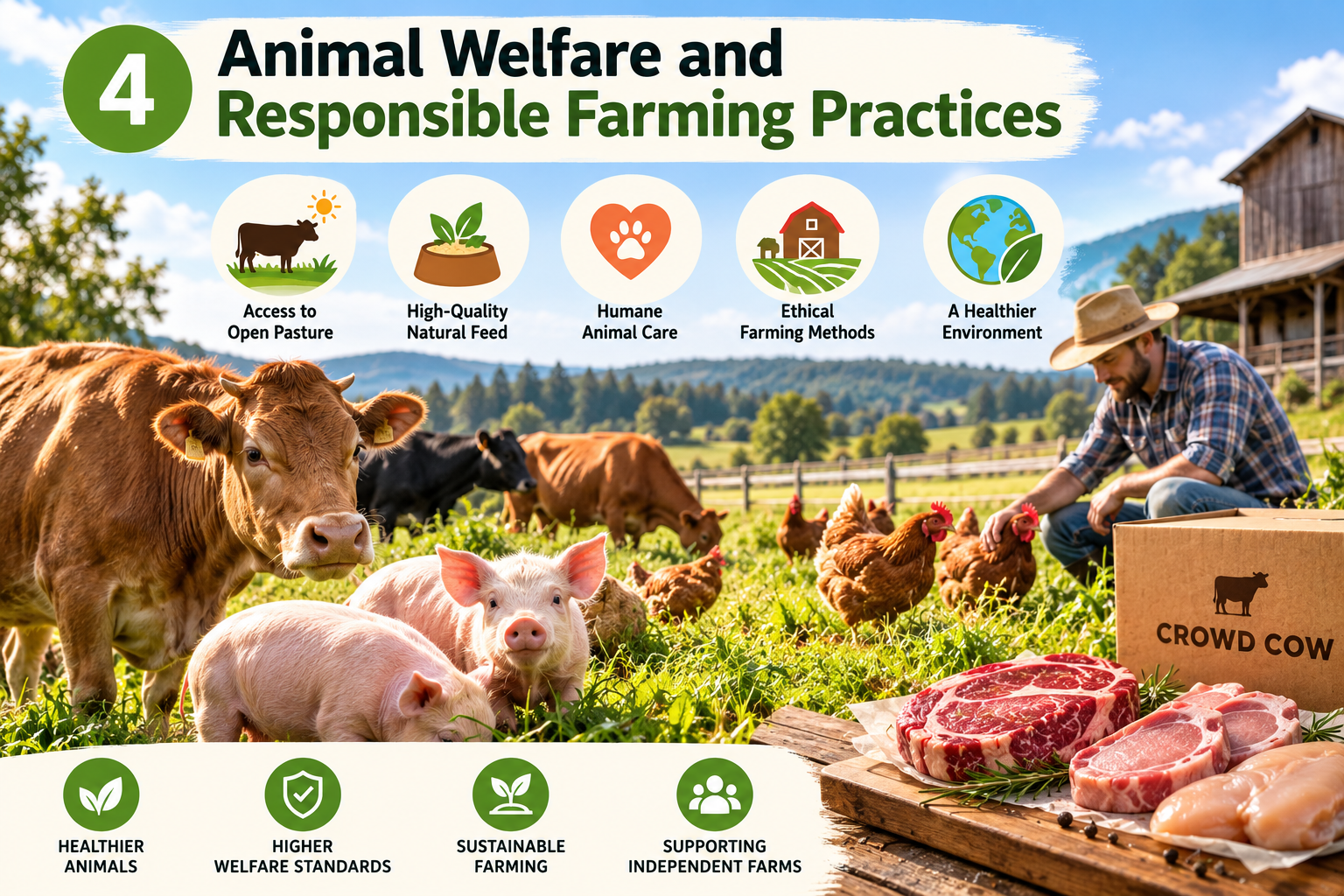
4. Animal Welfare and Responsible Farming Practices
Animal welfare is another factor frequently associated with responsible meat sourcing. Crowd Cowemphasizes producers that meet its sourcing standards and highlights farming practices associated with animal welfare and responsible production.
Responsible farming can involve many different factors. These can include access to pasture, animal handling, living conditions, transportation, breed selection, veterinary care, and overall farm management.
Because farms can use different systems, shoppers should examine individual producer information rather than assuming that every farm follows the same practices.
This is one reason producer-level information can be useful. Instead of treating "ethical meat" as a vague phrase, shoppers can look at concrete information about how animals were raised and how a particular producer operates.
For consumers who care strongly about animal welfare, the ability to investigate individual products and farms can make the shopping process more aligned with their personal priorities.
5. Meat Without Added Hormones and Unnecessary Antibiotics
Crowd Cow emphasizes meat sourced without added hormones and says its products are raised without unnecessary antibiotics.
This can be an important consideration for consumers who deliberately seek meat produced without routine or unnecessary interventions. It also gives shoppers another factor to consider when comparing products.
At the same time, consumers should understand the wording carefully. "Without unnecessary antibiotics" does not necessarily mean that an animal can never receive veterinary treatment. Responsible livestock management can involve treatment when animals become sick, and specific certifications may have their own requirements.
For shoppers who have particular standards, checking the product description and any relevant certification information is the best approach. Rather than assuming that all meat follows exactly the same system, it makes sense to examine the details associated with the individual product.
Responsible sourcing is not only about farming philosophy. Many shoppers also want meat that tastes exceptional, and Crowd Cow places considerable emphasis on product quality.
The marketplace includes premium options such as Japanese Wagyu, American Wagyu, pasture-raised beef, grass-fed beef, heritage pork, and specialty chicken.
Quality can vary according to breed, cut, aging, feed, animal management, and preparation. That makes the ability to explore different producers especially interesting for home cooks.
A person who normally buys supermarket steak might discover that two ribeyes from different producers have noticeably different characteristics. One might have more pronounced marbling, another might have a stronger beef flavor, while another could have characteristics associated with grass-fed production.
For food enthusiasts, this creates something similar to a tasting journey. Instead of viewing beef as one uniform category, you can explore how producer, breed, geography, and farming approach influence the final meal.
7. Specialty Meats That Are Harder to Find Locally
One of Crowd Cow's attractions is access to meats that may be difficult to find at an ordinary grocery store.
The marketplace includes specialty Wagyu, heritage pork, grass-fed beef, pasture-raised chicken, and products from different producers and regions.
This matters particularly for people who enjoy cooking as a hobby. A home chef might want a particular Wagyu cut for a special dinner, heritage pork for a slow-cooked recipe, or a specialty chicken for a weekend roast.
Online sourcing can effectively turn the internet into a much larger butcher counter. Instead of being limited to whatever happens to be stocked at the nearest supermarket, shoppers can explore a wider selection and compare producers.
That variety can also make premium meat suitable for special occasions. A high-quality steak or specialty cut can become the centerpiece of a birthday dinner, holiday meal, date night, or dinner party.
Responsible sourcing does not have to mean sacrificing convenience. Crowd Cowcombines producer-focused sourcing with direct-to-consumer delivery, allowing customers to order meat online and receive it at home.
The products are shipped frozen using insulated packaging and dry ice, while individual cuts can be vacuum-sealed. This system is designed to keep the products frozen during transportation and make them easier to store once they arrive.
That model can be particularly convenient for people who want specialty meat but do not live near a high-quality butcher or farm shop. Instead of driving across town searching for a particular cut, customers can browse online, select products, and arrange delivery.
There is also a practical advantage to frozen meat. When handled correctly, freezing allows consumers to store products and plan meals without feeling pressured to cook everything immediately.
Individually packaged portions can also make meal planning easier. You can take out exactly what you need while keeping the remaining products safely stored for later meals.
9. Flexible Ordering and Customizable Boxes
Crowd Cow provides flexibility in how customers build orders. Shoppers can select individual products and create boxes based on their preferences instead of being limited to a single predetermined assortment.
This can be useful for households with changing schedules. Perhaps one month you need more ground beef and chicken, while the next month you are preparing a dinner party and want steaks.
A customizable system allows customers to adapt their purchases according to their needs. That is particularly helpful for households where meat consumption changes from week to week.
Subscription-style ordering can also be convenient for people who already know which products they regularly use. Instead of remembering to place an order every time the freezer becomes empty, recurring delivery can simplify the routine.
At the same time, customers who prefer more control can choose individual products and manage their purchasing frequency according to their own schedules.
10. Sustainability Beyond the Farm
Responsible sourcing does not stop with how an animal is raised. Packaging, transportation, and food waste also matter.
Crowd Cowhas highlighted packaging designed to reduce waste and has discussed recyclable and compostable materials as part of its shipping system.
These measures do not eliminate the environmental impact associated with meat production or refrigerated shipping. That distinction is important because sustainability is a much larger issue involving land use, animal agriculture, feed, transportation, processing, refrigeration, and food waste.
Still, considering packaging alongside sourcing gives shoppers a broader framework for evaluating the overall purchasing experience.
For environmentally conscious consumers, it can be useful to look at the entire journey of a product rather than focusing on one label. The farm, production system, packaging, shipping method, and household food waste can all contribute to the final environmental footprint.
11. Understanding the Cost of Responsibly Sourced Meat
One question naturally follows all these benefits: Does responsibly sourced meat cost more?
In many cases, premium and specialty meat can carry a higher price than conventional supermarket alternatives. That is not surprising when products come from smaller producers, specialty breeds, particular production systems, or premium cuts.
The key is to compare value rather than simply looking at the sticker price.
If you are purchasing a premium steak for a special occasion, factors such as producer information, sourcing standards, cut quality, and convenience may influence whether the product fits your priorities.
Crowd Cow has also used order minimums and shipping thresholds, so customers should check the current checkout terms before placing an order because policies can change.
For budget-conscious shoppers, one practical strategy is to mix premium cuts with everyday products. Ground beef, chicken, roasts, and other versatile cuts can be used across multiple meals, while specialty steaks can be reserved for occasions when you want something exceptional.
This approach can make premium meat feel less like an everyday expense and more like a planned food experience.
Conclusion
Buying responsibly sourced meat is ultimately about having enough information to make a deliberate choice. Crowd Cow's approach is built around that idea: connect customers with farms and producers, provide information about sourcing, offer different production methods, and make specialty meat available through an online marketplace.
The biggest benefit may therefore be choice with context. Instead of seeing meat as an anonymous package, shoppers can investigate where it came from, which farm produced it, how animals were raised, and what characteristics make one product different from another.
There is no single definition of "responsibly sourced meat" that applies equally to every consumer. Some shoppers may prioritize grass-fed production, others may focus on animal welfare, traceability, independent farms, certifications, taste, or packaging.
The advantage of a producer-focused marketplace is that it gives consumers more information with which to compare those priorities. You can decide which characteristics matter most to you and select products accordingly.
For anyone who wants to move beyond anonymous commodity meat and explore a more transparent farm-to-door purchasing experience, Crowd Cow provides a convenient way to discover different producers, cuts, breeds, and production practices.
The smartest approach is to read individual product information carefully, understand the meaning of different sourcing claims, check relevant certifications when applicable, and choose products based on the specific practices that matter most to you.
Frequently Asked Question
What makes Crowd Cow different from a regular supermarket?
Crowd Cow focuses heavily on connecting customers with individual farms and producers. The platform provides producer information and offers a variety of meat products based on different breeds, farming practices, and sourcing methods. This gives shoppers more information to consider than they may receive from a conventional supermarket package.
Does Crowd Cow sell grass-fed beef?
Yes. Crowd Cow offers grass-fed beef, including products described as 100% grass-fed. It also offers other production styles, so customers should read individual product descriptions to understand exactly how a particular beef product was raised and finished.
Is Crowd Cow meat free from added hormones?
Crowd Cow states that its meat products are sourced without added hormones and emphasizes avoiding unnecessary antibiotics. Customers with specific dietary or sourcing requirements should always review the individual product information and any applicable certifications.
Can I choose which farm my meat comes from?
Crowd Cow provides producer information for many products, allowing shoppers to explore meat associated with specific farms and producers. Product availability can vary, so the available farms and products may change over time.
Is responsibly sourced meat more expensive?
It can be, particularly for specialty cuts, premium breeds, and products from particular farming systems. However, the marketplace includes a range of products, so customers can compare different cuts, sizes, producers, and prices to find options that fit their preferences and budget.