Digital Marketing Agency
EmailListVerify vs Other Email Verification Tools: Which One Wins?
Email marketing is a little like fishing in a huge ocean. You can cast the best bait, buy the most advanced equipment, and spend hours preparing, but if the water is full of trash instead of fish, you are wasting your time. That is exactly what happens when businesses send campaigns to outdated or invalid email addresses. Bounce rates go up, sender reputation drops, and email deliverability slowly crashes.
This is why email verification tools have become essential for marketers, SaaS companies, agencies, and cold outreach professionals. One tool that often appears in conversations is EmailListVerify. It promises affordable pricing, decent accuracy, fast processing, and bulk verification capabilities. But does it really outperform competitors like ZeroBounce, NeverBounce, Kickbox, Emailable, and DeBounce?
Many marketers are asking the same question today: should you choose a budget-friendly email verifier like EmailListVerify, or spend more on premium tools that claim higher accuracy? The answer depends on your goals, your budget, and the type of email campaigns you run.
Table of Contents
ToggleEmail marketing is still one of the highest ROI digital marketing channels in the world. Studies consistently show that businesses can generate impressive returns from email campaigns when their lists are clean and engaged. The problem is that email lists decay quickly. People switch jobs, abandon inboxes, create temporary emails, or simply stop using certain accounts. That means even a high-quality email list can become outdated within months.
When marketers ignore verification, the consequences pile up fast. Internet service providers like Gmail and Outlook monitor bounce rates closely. If your campaigns repeatedly hit invalid addresses, your sender reputation suffers. Eventually, even your legitimate emails may land in spam folders. It is similar to repeatedly knocking on doors in an empty neighborhood. After a while, people stop trusting you.
Modern verification tools act like quality inspectors before your campaigns launch. They scan email addresses, check syntax, validate MX records, identify disposable emails, and sometimes even detect spam traps. Without these checks, businesses risk damaging domains they spent years building. For cold outreach campaigns, the risk becomes even higher because bounce thresholds are stricter.
The growing popularity of email verification tools shows how important deliverability has become. Businesses no longer want to gamble with email lists. Instead, they want measurable accuracy, automation, and scalable solutions that can handle millions of records efficiently.
Invalid emails cost more than many marketers realize. The direct costs include wasted ad spend, higher email platform fees, and reduced campaign efficiency. But the hidden costs are even more dangerous. Poor deliverability lowers open rates, weakens customer engagement, and can reduce future inbox placement across all campaigns.
According to several review platforms and user reports, businesses that cleaned their email lists saw immediate improvements in bounce reduction and deliverability rates. That means verification is not just about removing bad emails; it is about improving overall marketing performance.
Think of sender reputation as a credit score for email marketers. Every bounce, spam complaint, and invalid address affects how mailbox providers evaluate your domain. Verification tools help maintain that reputation by filtering out risky contacts before campaigns begin.
Email verification platforms also identify spam traps and disposable emails. Spam traps are especially dangerous because hitting them can seriously damage your domain authority. Tools like EmailListVerify advertise spam trap detection and SMTP validation as key features for maintaining clean lists.

EmailListVerify is a bulk email verification platform designed to help businesses clean email databases and improve deliverability. The company positions itself as a budget-friendly alternative to premium competitors while still maintaining strong verification accuracy.
One reason marketers like EmailListVerify is its pricing structure. Pay-as-you-go plans start around $5 for 1,000 verifications, and credits reportedly never expire. This makes the tool attractive for startups, agencies, and freelancers that want flexibility without large monthly commitments.
The platform supports CSV, TXT, and XLS uploads, offers API access, and performs multiple validation checks including syntax verification, MX record checks, spam trap detection, and disposable email filtering. Users also mention that processing speeds are relatively fast even for larger datasets.
Still, affordability alone does not guarantee victory. Accuracy, integrations, support quality, and catch-all handling matter just as much in competitive email outreach environments.
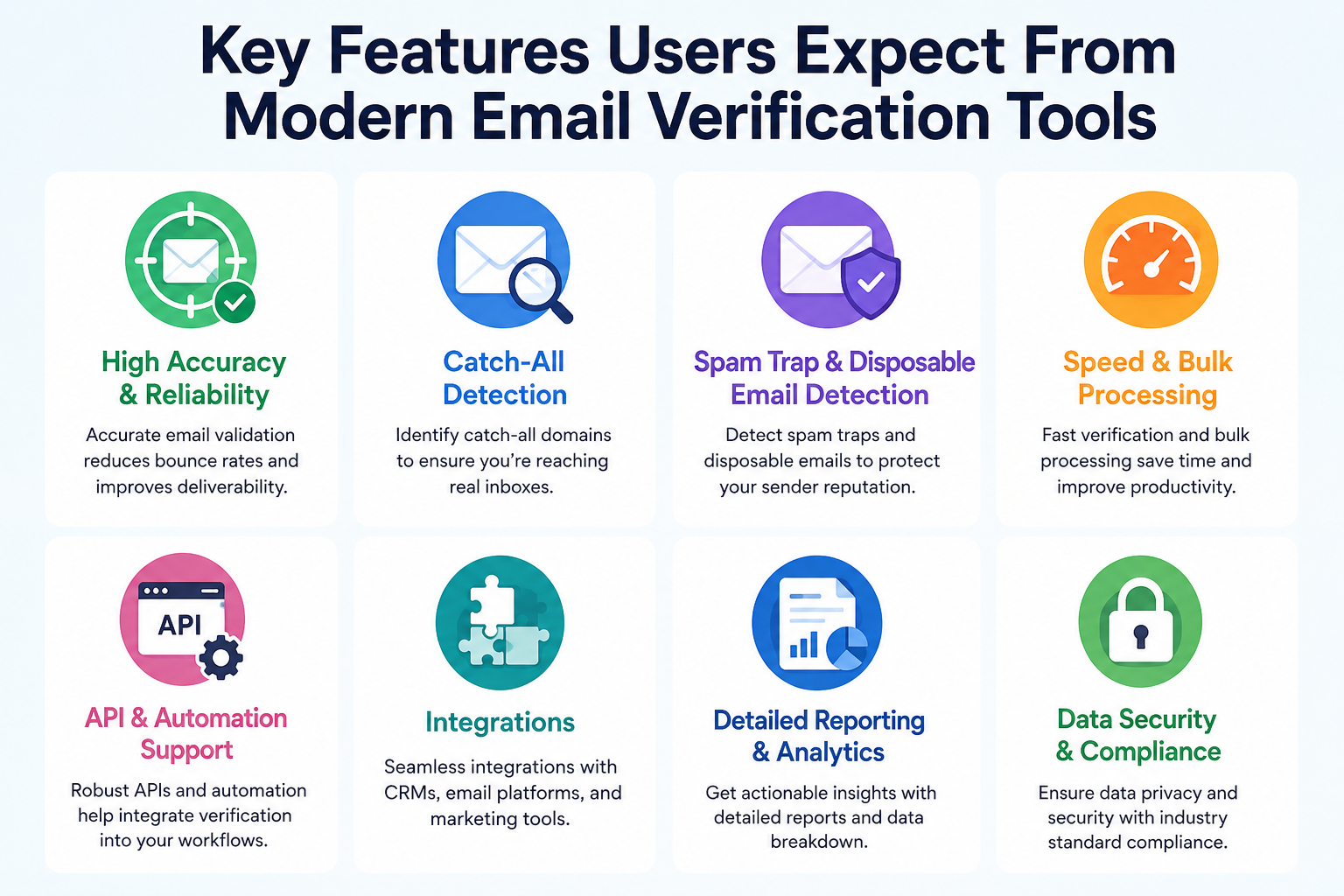
EmailListVerify includes several features commonly expected from modern verification platforms:
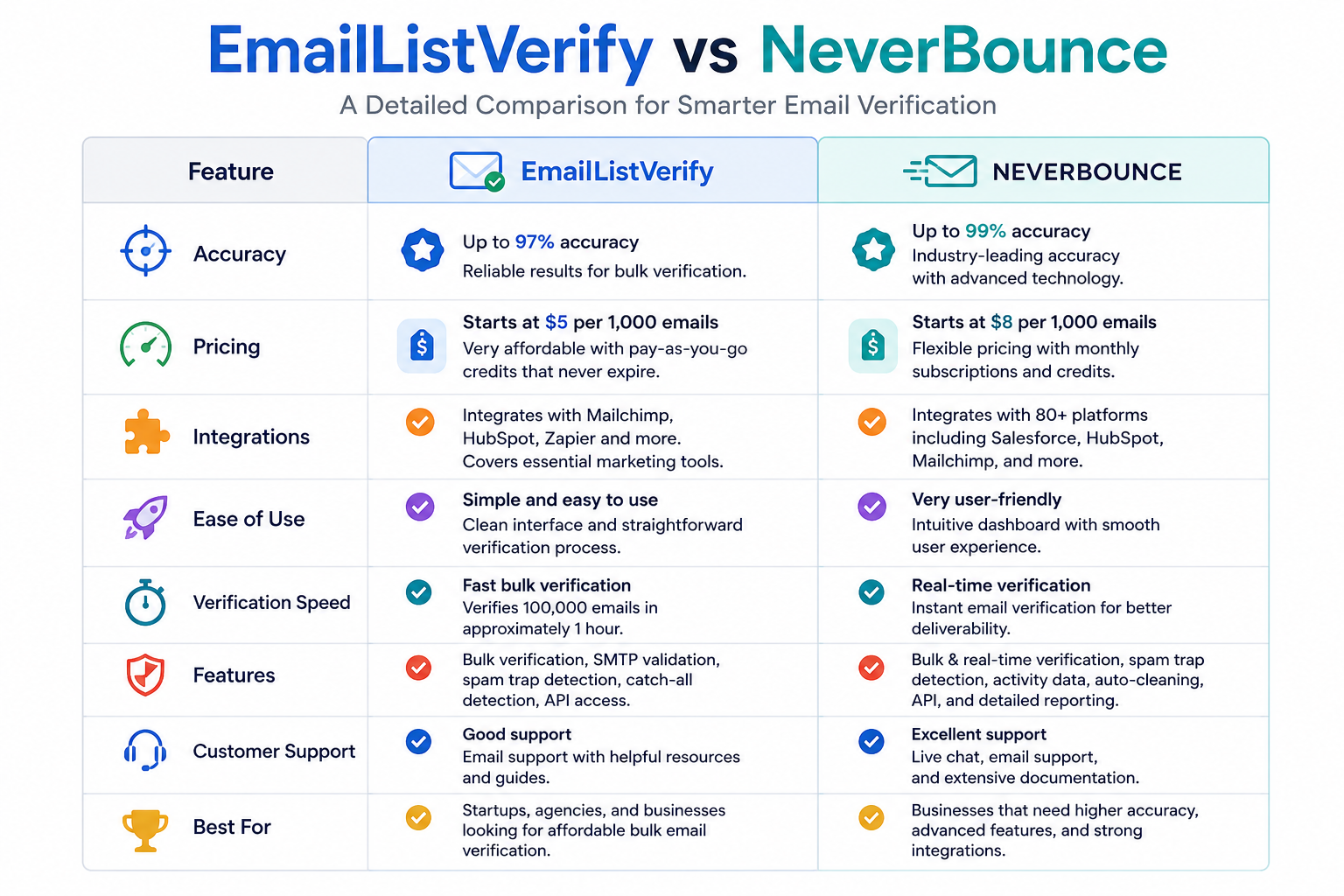
The company claims approximately 97% verification accuracy. However, some independent reviewers suggest actual accuracy can vary depending on list quality and catch-all domains.
EmailListVerify is often recommended for businesses that process large email lists while keeping costs low. Agencies managing multiple clients may find the pricing appealing. SaaS companies with growing databases also benefit from scalable verification without expensive enterprise contracts.
It may not be ideal for every situation, though. Enterprise outreach teams that depend heavily on catch-all accuracy may prefer more advanced solutions like ZeroBounce or Emailable. Those platforms typically invest more heavily in predictive scoring and advanced deliverability intelligence.
Choosing an email verification tool today is not simply about removing invalid emails. Businesses expect platforms to act like deliverability assistants that improve inbox placement and campaign performance overall.
Accuracy is the heartbeat of every verification platform. If a tool incorrectly labels valid emails as invalid, businesses lose potential customers. If it allows risky emails to slip through, bounce rates increase.
Catch-all domains are one of the biggest challenges in verification. These domains accept all incoming emails temporarily, making validation difficult. Some reviews suggest EmailListVerify struggles slightly in this area compared to premium competitors.
Premium platforms like ZeroBounce and Emailable often advertise 98–99% accuracy alongside stronger catch-all handling. That difference may sound small, but for large-scale outreach campaigns, even 1% matters significantly.
Modern businesses want automation. Manual uploads are no longer enough. Developers need APIs that integrate seamlessly with CRMs, lead forms, and SaaS workflows.
EmailListVerify offers API functionality across pricing tiers. This is useful for businesses that need real-time verification at signup forms or automated lead generation systems.
Still, some users report occasional API latency issues during heavy workloads. For enterprises processing millions of requests, uptime and response consistency become major evaluation factors.
Processing speed matters when handling large databases. Nobody wants verification jobs running for days before campaign launches.
Users frequently praise EmailListVerify for fast bulk processing. Some reports mention 100,000 email checks completed within an hour. That makes the platform attractive for agencies and marketing teams operating on tight schedules.
ZeroBounce is often considered one of the premium leaders in the email verification industry. It combines verification with deliverability monitoring, inbox placement tools, blacklist tracking, and email scoring.
EmailListVerify clearly wins on affordability. Pricing starts around $5 per 1,000 verifications. ZeroBounce tends to charge higher rates because it includes additional deliverability features and enterprise-grade infrastructure.
For startups or agencies verifying huge lists, EmailListVerify provides better cost efficiency. Businesses focused mainly on cleaning email databases may not need ZeroBounce’s advanced analytics.
Feature | EmailListVerify | ZeroBounce |
Starting Price | $5 per 1,000 emails | Higher premium pricing |
Free Credits | 100 free credits | Monthly free credits |
API Access | Yes | Yes |
Spam Trap Detection | Yes | Yes |
Deliverability Tools | Basic | Advanced |
Catch-All Accuracy | Moderate | Strong |
This is where ZeroBounce often gains the upper hand. Independent reviewers frequently mention that premium tools outperform budget verifiers on difficult validations like catch-all domains.
ZeroBounce also offers inbox placement tests and blacklist monitoring, which provide broader deliverability management. Businesses relying heavily on outbound email campaigns may find these tools extremely valuable.
NeverBounce has built a strong reputation for integrations and automation capabilities. Many marketers love its smooth workflow integrations with CRMs and marketing platforms.
EmailListVerify earns praise for simplicity. Many users highlight the platform’s clean interface and quick learning curve. Even beginners can upload lists and process verifications without technical knowledge.
NeverBounce, however, offers a more polished enterprise experience with deeper analytics and workflow automation. Larger organizations may appreciate those advanced controls.
NeverBounce generally supports broader integrations out of the box. Businesses using Salesforce, HubSpot, Mailchimp, or automation platforms often prefer NeverBounce for native connectivity.
EmailListVerify supports integrations too, including Mailchimp, Zapier, and HubSpot. But its ecosystem is not as extensive as NeverBounce’s.
Kickbox is known for reliability and strong developer-friendly APIs. Many SaaS companies integrate Kickbox directly into signup forms for real-time email validation.
Kickbox performs well with real-time validation and enterprise scalability. Its infrastructure focuses heavily on API stability and performance consistency.
EmailListVerify still performs competitively for bulk list cleaning. Smaller businesses may not notice major differences in day-to-day usage. But high-volume SaaS companies requiring real-time verification at scale may lean toward Kickbox.
Kickbox emphasizes clean dashboards and intuitive reporting. EmailListVerify keeps things simpler and more budget-oriented. Some users prefer simplicity, while others want deeper reporting insights.
The choice often depends on business maturity. Startups may appreciate EmailListVerify’s straightforward approach, while enterprises prefer advanced reporting and analytics.
Why HubSpot Is the Best CRM for Small Businesses
Why GOVEE MOMENTS TRADING LIMITED Is Leading in RGB Innovation
Social Catfish vs BeenVerified: Which Tool is Better for Background Checks?
Lordhair Maintenance Guide: Make Your Hairpiece Last Longer
Why Sonetel Is the Smart Choice for International Calling
Emailable has gained popularity because of its speed and accuracy guarantees. It positions itself as a modern alternative focused on automation and performance.
Emailable advertises verification speeds reaching tens of thousands of emails per minute alongside high uptime guarantees. That makes it attractive for businesses handling large-scale real-time verification.
EmailListVerify also processes large batches quickly, but Emailable’s infrastructure may offer more stability under enterprise-level workloads.
Support quality often separates good tools from great tools. User reviews for EmailListVerify are generally positive, although some mention occasional slow responses.
Premium tools like Emailable and ZeroBounce typically invest more heavily in dedicated support teams and onboarding assistance.
Tool | Starting Price | Accuracy Claim | Best For | Free Credits |
EmailListVerify | $5/1,000 emails | 97% | Budget-friendly bulk cleaning | 100 |
ZeroBounce | Premium pricing | 98%+ | Enterprise deliverability | Monthly credits |
NeverBounce | Mid-to-premium | High | CRM integrations | Limited |
Kickbox | Premium | High | Real-time API validation | Trial credits |
Emailable | Mid-range | 99% | Fast verification | 250 free |
Every tool has strengths and weaknesses, and EmailListVerify is no exception.
Pros | Cons |
Affordable pricing | Slightly weaker catch-all accuracy |
Fast bulk verification | Fewer advanced deliverability tools |
API included | Limited enterprise analytics |
Easy-to-use interface | Some reports of API latency |
Credits never expire | Smaller integration ecosystem |
One major advantage is cost efficiency. For marketers handling massive lists, the savings can be substantial compared to premium alternatives. On the downside, businesses running mission-critical cold outreach campaigns may prefer more advanced deliverability intelligence.
Different businesses need different solutions. There is no universal winner because use cases vary dramatically.
Startups often prioritize affordability and simplicity. EmailListVerify performs extremely well here because of its low pricing and easy onboarding. Small teams can verify thousands of emails without stretching their budgets.
Enterprise organizations usually care more about infrastructure reliability, support quality, analytics, and integrations. ZeroBounce, NeverBounce, and Kickbox often outperform budget platforms in these areas.
Cold outreach campaigns require extremely low bounce rates. Catch-all accuracy becomes critical because even small mistakes can damage sending domains. Premium tools generally provide stronger protection for high-volume outbound operations.
That said, many agencies still choose EmailListVerify because the price-to-performance ratio remains attractive. It is similar to buying a reliable economy car instead of a luxury vehicle. Both reach the destination, but one includes more premium features.
So, does EmailListVerify beat other email verification tools?
The honest answer is both yes and no.
If your priority is affordability, fast bulk processing, and decent core verification, EmailListVerify is one of the strongest value options on the market. It offers features that many businesses genuinely need without forcing expensive enterprise contracts. For startups, freelancers, agencies, and budget-conscious marketers, it delivers impressive value.
But if your business depends heavily on cold outreach, enterprise deliverability, advanced analytics, or superior catch-all accuracy, premium competitors like ZeroBounce, NeverBounce, Kickbox, and Emailable may justify their higher pricing.
EmailListVerify wins the value battle. Premium tools often win the precision battle.
The best choice ultimately depends on how much risk your campaigns can tolerate and how important advanced deliverability intelligence is to your business.
Yes, many marketers use EmailListVerify for cold outreach because of its affordability and bulk verification speed. However, businesses running highly sensitive outbound campaigns may prefer premium tools with stronger catch-all accuracy.
Yes, EmailListVerify provides API access for automated verification workflows and real-time validation.
The company claims approximately 97% accuracy. Independent reviews suggest actual performance may vary depending on catch-all domains and dataset quality.
There is no single best tool for everyone. EmailListVerify excels in affordability, while ZeroBounce and Emailable often lead in enterprise accuracy and deliverability features.
Free tools can help with small tasks, but they often lack advanced verification methods like spam trap detection, SMTP validation, and catch-all handling. Paid platforms usually provide significantly better reliability and scalability.
times.software
Table of Contents
×