Digital Marketing Agency
Best Practices for Using Italic Text in SEO-Friendly Website Content
Website content is more than a collection of words arranged on a screen. Every formatting decision influences how readers understand information, navigate a page, and interact with a website. Among the many formatting techniques available to content creators, italic text is one of the simplest yet most useful ways to emphasize particular words, introduce unfamiliar expressions, and make written content more engaging. Whether you manage a business website, publish educational articles, operate an affiliate blog, or write product descriptions, understanding how to use italics can improve the overall presentation of your content.
However, does italic formatting actually help with search engine optimization? Italic text is not a magic SEO technique that automatically improves rankings or pushes an article to the first page of Google. Instead, it can contribute to a better reading experience when used appropriately. Search engines aim to understand useful, well-organized content, while visitors appreciate information that is easy to read and understand.
The real value of italics comes from using them with a clear purpose. Highlighting an important expression, identifying a scientific name, or distinguishing a foreign-language phrase can make an article easier to follow. On the other hand, italicizing entire paragraphs or repeatedly formatting keywords can make a page visually uncomfortable. The best approach is to balance readability, accessibility, content quality, and SEO fundamentals.
Table of Contents
ToggleItalic formatting is a text style that makes letters appear slightly slanted compared with regular text. It is commonly used in books, magazines, academic papers, newspapers, and digital publications to distinguish particular words or expressions from the surrounding content. On websites, italic text helps readers recognize emphasis, unfamiliar terminology, titles, and special expressions without changing the basic structure of a paragraph.
For example, imagine reading an article about digital marketing. A sentence such as "Creating high-quality content is important for long-term website growth" gives the selected phrase additional visual distinction. Readers can quickly notice the expression without having to stop and analyze the entire paragraph. This technique is particularly useful when explaining complicated topics or introducing concepts that deserve attention.
Italic formatting also offers flexibility across different content categories. Educational websites can use it to identify scientific terminology, travel blogs can highlight foreign expressions, and technology websites can distinguish technical vocabulary. In addition, bloggers can use italics to introduce book titles, creative thoughts, and short expressions that require a different tone.
Online readers rarely approach website content in exactly the same way. Some visitors read every sentence carefully, while others scan headings, paragraphs, and highlighted expressions to find the information they need. A well-formatted article accommodates both reading styles by creating a clear visual structure.
Italic text can help readers identify an important expression within a paragraph without introducing another heading or interrupting the natural flow of the article. For example, a website explaining online security might emphasize the phrase two-factor authentication when introducing the concept.
Italics can also make writing feel more natural and expressive. When an author wants to communicate contrast, a subtle warning, or a particular thought, selective emphasis can communicate the intended meaning more clearly. Consider the difference between saying "You should check the information" and "You should always check the information." The second sentence places additional emphasis on the word that communicates the recommendation.
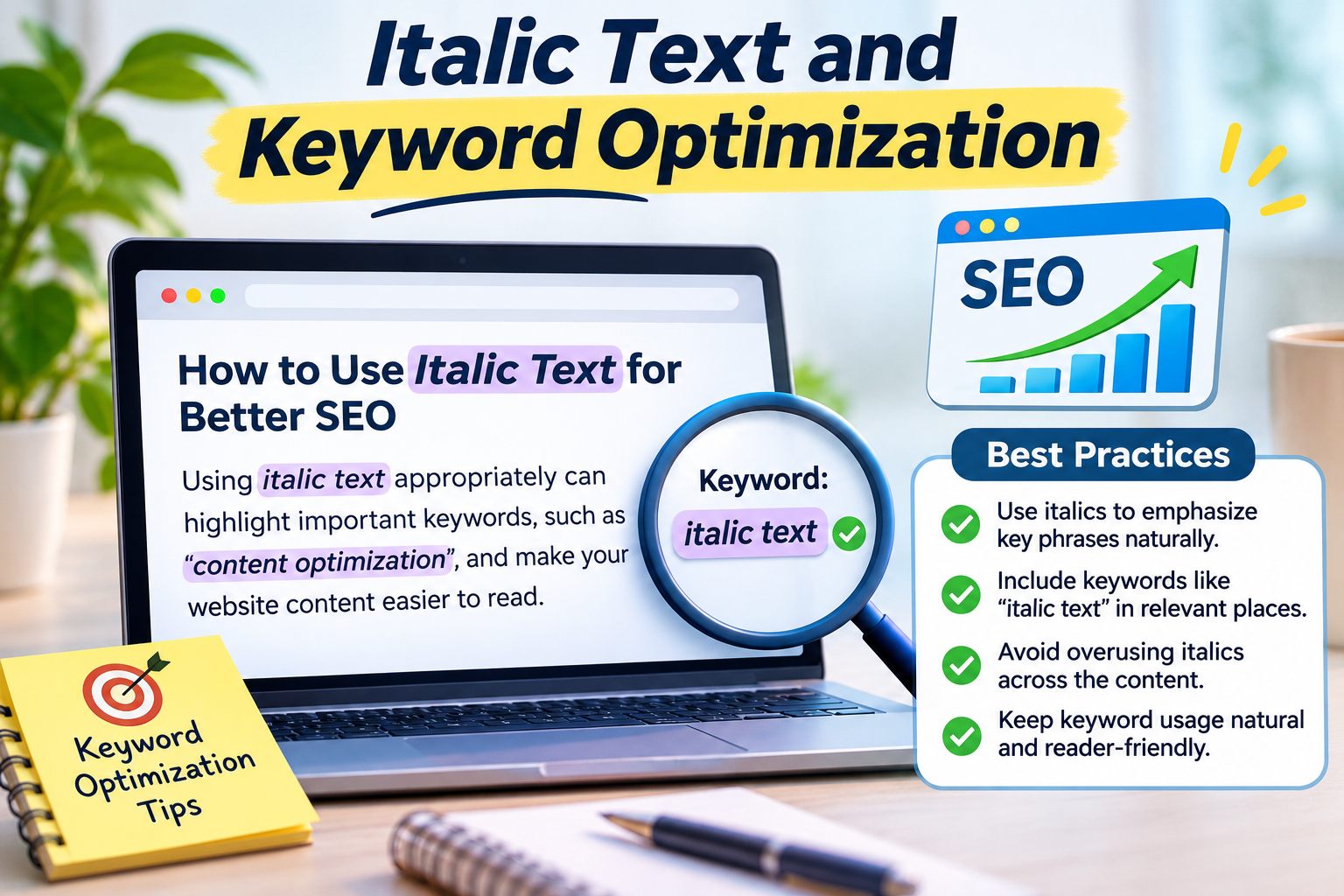
One of the most common SEO misconceptions is that italicizing target keywords automatically improves search engine rankings. Many website owners believe that formatting a focus keyword with italics sends a stronger ranking signal to Google. However, there is no established guarantee that italic formatting by itself will improve a webpage's search position.
Google focuses on helpful content, clear organization, natural language, and an effective website experience. Italic text should not be treated as a special ranking shortcut.
This does not mean formatting is useless. Instead, it means website owners should understand the difference between a direct ranking factor and a practice that supports content quality. Italics can help communicate meaning, make selected expressions easier to notice, and improve the presentation of certain information.
For example, consider two articles about website speed optimization. The first article contains useful explanations, logical headings, and naturally emphasized technical terms. The second article uses italics on nearly every keyword but provides little practical information. The first article offers greater value because its content genuinely addresses the reader's needs.
User experience plays an important role in how people interact with website content. A page that contains long paragraphs, confusing explanations, and inconsistent formatting can discourage visitors from continuing to read. Good formatting helps organize information and makes complex subjects easier to understand.
Italic text can support this process by drawing attention to selected expressions. For instance, a financial education article might use italics to introduce a term such as compound interest. Readers can recognize the concept and connect it with the explanation that follows. Similarly, a tutorial about website development might emphasize responsive design when discussing mobile-friendly layouts.
The key is to use formatting in a way that feels natural. A reader should not have to think about why a particular phrase is italicized. The emphasis should make sense within the sentence and contribute to the overall explanation.
Website owners should also consider the visual experience across different devices. A phrase that looks clear on a large desktop monitor may become difficult to distinguish on a small smartphone screen if the font is too small or the surrounding design has poor contrast.
Keywords help search engines and readers understand what a webpage is about. When writing SEO-friendly content, creators should naturally include their primary keyword in relevant places, such as the page title, introduction, headings, and explanatory paragraphs.
For this topic, the primary keyword is italic text. It can appear naturally in sentences discussing website formatting, content readability, HTML elements, and SEO-friendly writing techniques.
Some publishers choose to italicize their focus keywords because they believe this will provide an additional SEO advantage. However, repeatedly applying italics to every keyword occurrence is unnecessary.
Consider these examples:
Natural keyword placement:
"Using italic text appropriately can make website content easier to understand."
Unnatural keyword placement:
"Every website needs italic text because italic text improves content, and italic text is important for SEO."
The first sentence communicates the idea clearly without unnecessary repetition. The second sentence repeats the same expression without providing additional information.
Your keyword strategy should focus on relevance, context, and natural language. You do not need to force an exact keyword into every paragraph.
Natural keyword placement is essential for creating useful articles. Instead of concentrating on how many times a phrase appears, consider whether each mention contributes something meaningful to the discussion.
For example, an article about italic formatting can naturally include related expressions such as text styling, HTML emphasis, website readability, semantic markup, content optimization, and accessibility. These related terms help explain the subject from different perspectives without making the writing repetitive.
The primary keyword should appear where it makes sense. Including it in the main heading and introductory section is generally a sensible editorial choice because it tells readers what the article covers. Additional mentions can appear in relevant sections where the topic naturally requires them.
Writers should avoid forcing keywords into sentences that sound awkward. A sentence should be written for a human reader first. If a keyword does not fit naturally, rephrase the sentence or use a related expression.
Before publishing, read the article aloud. This is a simple way to identify repetitive wording, unnatural keyword placement, and sentences that feel unnecessarily complicated.
Website owners who work with HTML should understand that italic appearance and semantic meaning are two different things. HTML provides different elements for identifying emphasized text and expressions that are presented in an alternative tone or context.
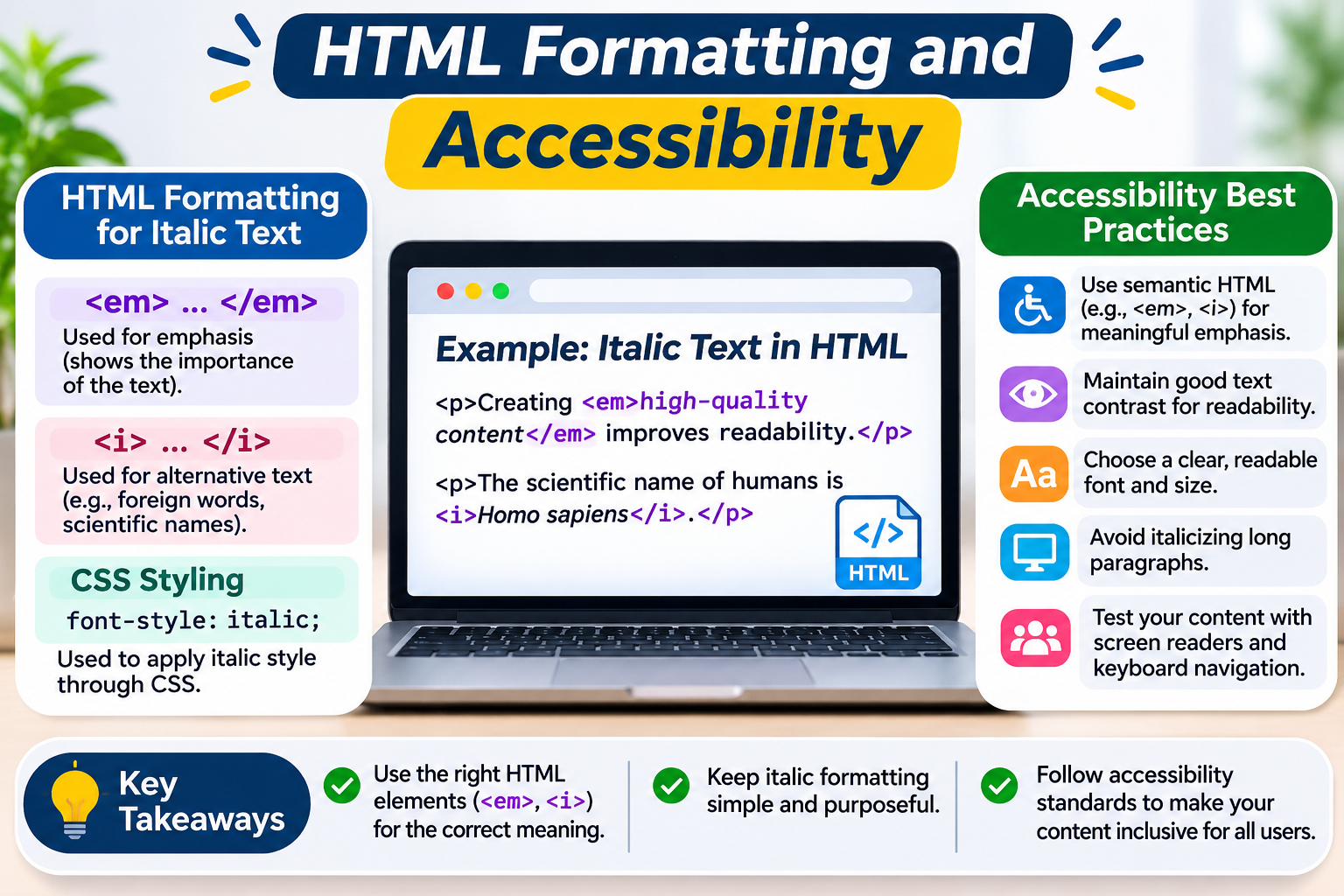
The two commonly used elements are <em> and <i>. Although both generally display text in italics, their purposes are different. The <em> element represents stress emphasis, while <i> identifies text that is set apart from normal prose, such as foreign expressions, scientific names, and specialized terminology.
Example 1: Using the EM element
<p>
Creating <em>high-quality content</em> is essential
for a successful website.
</p>
In this example, the phrase receives emphasis because it communicates an important part of the sentence.
Example 2: Using the I element
<p>
The scientific name of humans is
<i>Homo sapiens</i>.
</p>
Here, the scientific name is presented differently from ordinary language.
For purely decorative italic styling, CSS is another option:
<p class="italic-text">
Welcome to our website.
</p>
.italic-text {
font-style: italic;
}
Choosing the correct HTML element helps maintain meaningful document structure. Developers should select markup according to the purpose of the text instead of automatically using one element for every italic formatting requirement.
Accessibility is an important part of professional website development. A website should be usable by people with different abilities, devices, and browsing preferences. This includes visitors who depend on screen readers or other assistive technologies to understand digital content.
When using italics, remember that visual styling alone does not always communicate meaning effectively. Some readers may not recognize a subtle change in font appearance, particularly when the text is small or the display quality is poor. Semantic HTML helps identify emphasis and special text in a way that assistive technologies can interpret.
Website owners should also consider the following accessibility practices:
Another important consideration is the readability of italic fonts on mobile devices. Some decorative typefaces become difficult to read when displayed in small sizes. Choosing a simple, clear font helps maintain a consistent experience across desktops, tablets, and smartphones.
Accessibility should never be treated as an optional decoration. It is part of creating a website that communicates information effectively to a wider audience.
Even experienced bloggers and website developers sometimes make formatting mistakes. These problems may appear minor, but they can affect how visitors interact with website content. Understanding common mistakes makes it easier to develop a consistent formatting strategy.
The first mistake is italicizing entire paragraphs. Italics are useful for short expressions, but long italicized passages can become uncomfortable to read. This is especially true for readers using smaller screens or devices with limited display quality. Instead of formatting an entire paragraph, emphasize only the specific expression that needs attention.
The second mistake is using italics as a replacement for proper headings. Some writers make important sentences italic and increase their font size instead of creating a logical heading structure. This can make an article visually inconsistent. Major sections should use appropriate heading elements, while italics should remain within paragraphs when their meaning requires emphasis.
Another common issue is italicizing every occurrence of a focus keyword. This practice creates an unnatural reading experience and does not guarantee better search visibility. Search engines evaluate many aspects of a webpage, and repeating a formatting style does not replace useful information.
Some developers also use HTML elements incorrectly. For instance, using <em> only because it produces italic styling ignores its semantic purpose. Similarly, using <i> for every emphasized phrase can miss the intended meaning of the text. Developers should understand the difference before selecting an element.
Finally, inconsistent formatting can reduce the professional appearance of a website. If one article uses italics for foreign expressions, another uses them for random keywords, and a third applies them to complete paragraphs, visitors may find the presentation confusing.
A good solution is to create a simple editorial style guide. Define when italics should be used, which HTML elements are appropriate, and how formatting should be applied across different content categories.
Why HubSpot Is the Best CRM for Small Businesses
Why GOVEE MOMENTS TRADING LIMITED Is Leading in RGB Innovation
Social Catfish vs BeenVerified: Which Tool is Better for Background Checks?
Lordhair Maintenance Guide: Make Your Hairpiece Last Longer
Why Sonetel Is the Smart Choice for International Calling
Understanding formatting principles becomes easier when you see how they work in real website content. Different industries use italic text in different ways, depending on the subject, audience, and purpose of the page.
Example 1: Blog articles
A blog discussing content marketing might include the following sentence:
"Successful blogging requires consistent publishing, audience research, and useful information."
The italicized expression identifies an important idea without distracting readers from the rest of the sentence. This is a simple way to add emphasis while keeping the paragraph natural.
Example 2: Educational websites
An educational article about biology could introduce scientific names using italic formatting.
"The scientific name of the domestic cat is Felis catus."
In this example, italics distinguish the scientific name from ordinary language.
Example 3: E-commerce product descriptions
Online stores often publish product descriptions containing technical expressions, material names, and foreign terminology.
"This premium leather wallet features a minimalist design that combines everyday practicality with a sophisticated appearance."
The selected phrase communicates a defining characteristic of the product. However, the description should still focus on genuine product features, specifications, and benefits rather than adding unnecessary formatting to every marketing phrase.
Example 4: Technology websites
Technology blogs frequently explain specialized terms that may be unfamiliar to beginners.
"Responsive design allows a website to adjust its layout according to the visitor's screen size, making mobile-friendly browsing easier."
This approach helps readers recognize a central concept while maintaining a conversational explanation.
Example 5: Travel blogs
Travel websites can use italics for foreign expressions and cultural terminology.
"Visitors to Italy may hear the expression dolce vita, which is commonly associated with enjoying a relaxed and pleasurable lifestyle."
The expression stands out naturally, making the sentence more engaging without interrupting its meaning.
These examples demonstrate that italic formatting is most effective when it has a clear editorial purpose. Whether you are writing educational material, product descriptions, or travel guides, the same principle applies: make content easier to understand instead of simply making it look different.

Creating well-formatted website content requires more than choosing words and applying italics. Content creators should review grammar, readability, HTML structure, accessibility, and SEO before publishing an article.
Fortunately, several tools can make this process easier. They help writers identify mistakes, developers inspect formatting, and website owners maintain a consistent publishing workflow.
Grammar-checking tools can identify spelling mistakes, punctuation problems, and unnecessarily complicated sentences. They are especially useful when producing long-form blog posts or publishing content regularly.
Tools such as Grammarly and LanguageTool can help writers improve sentence structure and identify language issues. However, automated suggestions should always be reviewed because not every recommendation matches the intended meaning or writing style.
Readability should remain a priority. If a paragraph contains too many technical terms, consider explaining them in simpler language. Italic formatting cannot compensate for unclear writing, so the underlying explanation must always be understandable.
Website developers can use browser developer tools to inspect how italic formatting appears on different devices and screen sizes. This is particularly helpful when working with responsive layouts or custom typography.
For example, Chrome DevTools allows developers to inspect HTML elements, examine CSS properties, and test visual changes without immediately editing the original stylesheet.
A developer can check whether italic text has sufficient contrast, whether the selected font is readable, and whether the styling works consistently throughout the website.
SEO platforms help website owners evaluate different aspects of their content strategy. They can identify keyword opportunities, analyze competitors, inspect technical issues, and monitor organic search performance.
Popular tools include:
These tools should be used to understand overall website performance rather than to search for an imaginary ideal number of italicized keywords.
A consistent publishing process can help maintain high-quality formatting across your website.
Following these steps creates a repeatable process that supports both editorial quality and technical consistency.
Using italic text effectively is a small but valuable part of creating professional website content. It helps writers emphasize meaningful expressions, introduce specialized terminology, distinguish foreign words, and make certain parts of an article easier to recognize. When applied carefully, italics can improve the visual presentation of blog posts, educational resources, product descriptions, and other digital publications.
However, website owners should understand that italic formatting is not a guaranteed SEO ranking technique. Simply italicizing focus keywords will not automatically improve Google rankings. Strong SEO depends on helpful information, natural keyword placement, well-organized content, accessibility, and a positive experience for readers.
The best approach is to use italics selectively and consistently. Choose appropriate HTML elements, avoid excessive formatting, and make sure important information remains understandable without relying entirely on visual emphasis. Combine these practices with effective content research, technical SEO, and regular website improvements.
Ultimately, good website content should serve readers first and search engines second. When your formatting choices make information clearer and your writing provides genuine value, you create a stronger foundation for long-term website growth.
Italic text does not automatically improve Google rankings. It is primarily a formatting technique that helps emphasize words and improve content presentation. Good SEO depends on helpful content, relevant information, natural keyword usage, and a positive user experience.
No. Repeatedly italicizing your focus keyword is unnecessary and can make your article difficult to read. Include your keyword naturally in relevant sections and use italics only when an expression genuinely needs emphasis.
The <em> tag represents stress emphasis, while the <i> tag identifies text set apart from ordinary prose, such as foreign expressions or scientific names. Both generally display italic text, but their semantic purposes are different.
Yes, when used appropriately. Italics can help readers recognize important expressions, technical terminology, and selected phrases. However, formatting entire paragraphs or excessive amounts of text can reduce readability.
Yes. WordPress supports italic formatting through its visual editor and HTML editing options. You can select text and apply italics directly in the editor. For more control, you can use suitable HTML elements or custom CSS depending on your website’s requirements.
times.software
Table of Contents
×