Notice: Function Elementor\Core\Experiments\Manager::warn_removed_or_hidden_dependency was called incorrectly. Feature mega-menu depends on hidden experiment nested-elements. Please see Debugging in WordPress for more information. (This message was added in version 4.3.2.) in /home/u327571181/domains/times.software/public_html/wp-includes/functions.php on line 6260 Strategy11: A Complete Guide to Building a Winning Digital Marketing Plan - Times Software
Strategy11: A Complete Guide to Building a Winning Digital Marketing Plan
Recent industry research shows that businesses with a clearly defined digital marketing strategy consistently achieve better customer engagement, stronger lead generation, and higher ROI than those relying on disconnected marketing tactics. Modern marketers are increasingly focusing on integrated strategies that align business goals, audience needs, content creation, SEO, social media, paid advertising, and analytics into one unified framework.
The Strategy11 framework is a structured approach to creating a successful digital marketing plan by breaking the process into twelve manageable and measurable stages. Many businesses struggle with marketing because they jump directly into running ads, posting on social media, or creating content without having a strategic foundation. Strategy11 eliminates this problem by providing a roadmap that ensures every marketing activity supports a broader business objective.
Think of digital marketing like building a house. You would never start with the roof before laying a strong foundation. Yet many businesses approach marketing exactly that way. They focus on tactics before strategy. The Strategy11 model encourages marketers to establish goals, understand audiences, analyze competitors, and develop a complete marketing ecosystem before investing significant resources.
The beauty of Strategy11 lies in its flexibility. Whether you're a startup trying to generate your first leads, an e-commerce brand aiming to increase sales, or an established company seeking market expansion, the framework adapts to your unique objectives. Each step builds upon the previous one, creating a cohesive marketing system rather than isolated campaigns.
In today's competitive digital landscape, customer expectations continue to rise. Consumers expect personalized experiences, valuable content, seamless website interactions, and consistent messaging across multiple channels. Strategy11 helps businesses meet these expectations while maintaining a clear focus on measurable business growth.
Why Every Business Needs a Digital Marketing Plan
A digital marketing plan acts as a blueprint that guides every marketing decision. Without a plan, businesses often waste time, money, and resources pursuing tactics that fail to deliver meaningful results. Research indicates that successful organizations consistently align marketing activities with business goals and customer needs.
Imagine embarking on a road trip without a destination, map, or GPS. You might eventually reach somewhere, but the journey would be inefficient and costly. Digital marketing works the same way. A plan provides direction, helps prioritize activities, and creates accountability across teams.
One major benefit of having a structured marketing plan is improved resource allocation. Marketing budgets are often limited, particularly for small and medium-sized businesses. A clear
ensures that investments are directed toward channels and campaigns most likely to generate positive returns. Rather than spreading resources too thinly across numerous platforms, businesses can focus on what truly works.
Another advantage is improved performance measurement. When goals and key performance indicators are established from the beginning, it becomes much easier to evaluate success. Marketers can identify strengths, uncover weaknesses, and make data-driven adjustments that improve campaign effectiveness over time.
Most importantly, a digital marketing plan fosters consistency. Customers interact with brands through websites, social media, search engines, emails, and advertisements. A well-designed strategy ensures that every touchpoint communicates a unified message and reinforces brand identity.
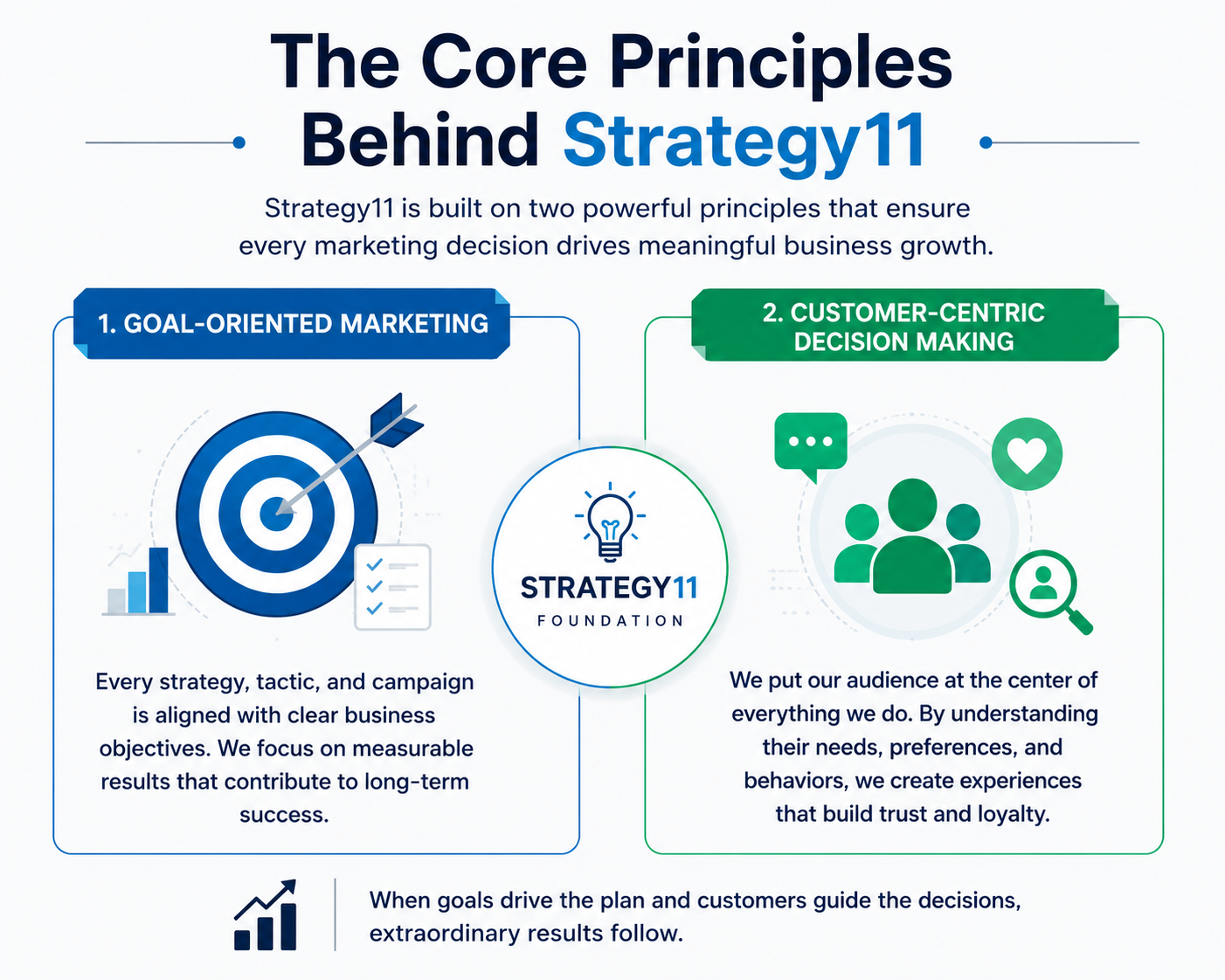
The Core Principles Behind Strategy11
Goal-Oriented Marketing
Successful marketing always begins with clear objectives. Goals provide direction and establish measurable outcomes. Whether the objective is increasing revenue, generating leads, improving customer retention, or enhancing brand awareness, every marketing effort should contribute to achieving that outcome.
Customer-Centric Decision Making
Modern marketing revolves around understanding customers. Every decision—from content creation to channel selection—should be based on customer needs, preferences, challenges, and behaviors. Businesses that genuinely understand their audiences are far more likely to build lasting relationships and drive sustainable growth.
Step 1: Define Clear Business Objectives
Every successful digital marketing strategy begins with clearly defined business objectives. These objectives serve as the foundation for all subsequent marketing activities. Without them, it becomes nearly impossible to determine whether marketing efforts are delivering meaningful results.
Effective objectives should follow the SMART framework: Specific, Measurable, Achievable, Relevant, and Time-bound. For example, rather than saying, "Increase website traffic," a SMART objective would be, "Increase organic website traffic by 30% within six months."
Clear objectives help teams stay focused and aligned. They also provide benchmarks for measuring success. When goals are well-defined, marketers can select appropriate tactics, allocate resources efficiently, and evaluate performance with confidence.
Organizations that connect digital marketing goals directly to business outcomes often experience stronger growth and greater accountability. This alignment ensures that marketing activities contribute to broader organizational success rather than operating in isolation.
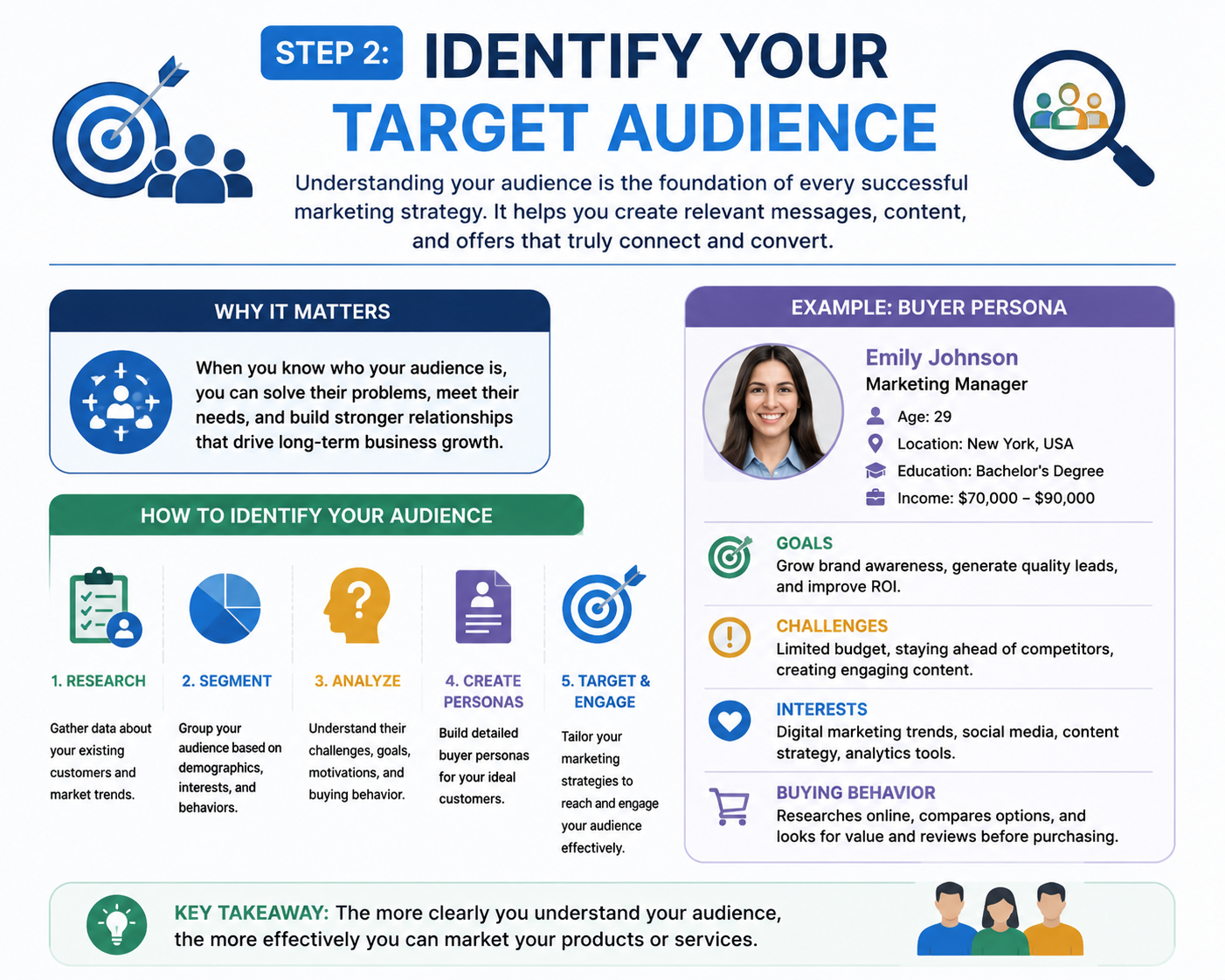
Step 2: Identify Your Target Audience
Building Detailed Buyer Personas
Understanding your audience is arguably the most critical aspect of digital marketing. Businesses cannot effectively communicate with customers they do not understand. Buyer personas help solve this challenge by creating detailed profiles of ideal customers.
A buyer persona typically includes demographic information such as age, gender, location, education level, and income. It also explores psychographic characteristics, including interests, motivations, values, challenges, and purchasing behaviors.
The more detailed the persona, the easier it becomes to create relevant content and personalized experiences. For instance, a software company targeting small business owners will communicate differently than a fashion brand targeting young consumers.
Customer research methods may include surveys, interviews, website analytics, social media insights, and customer feedback. The goal is to uncover patterns that reveal what customers truly need and how they make decisions.
Step 3: Analyze Your Competition
Competitive analysis provides valuable insights into market opportunities and threats. By studying competitors, businesses can identify successful strategies, uncover content gaps, and differentiate themselves effectively.
A thorough competitive analysis examines:
Area
What to Analyze
SEO
Keywords, rankings, backlinks
Content
Blog topics, formats, engagement
Social Media
Audience growth, posting frequency
Advertising
Ad creatives, targeting strategies
Website
User experience, conversion paths
Competitor research should not focus on imitation. Instead, it should inspire innovation. Understanding what competitors do well allows businesses to improve upon existing approaches and discover unique positioning opportunities.
Successful brands often win by identifying underserved customer needs rather than simply replicating market leaders.
Before launching new initiatives, businesses should evaluate their current marketing performance. A digital marketing audit provides a comprehensive assessment of existing assets, channels, and campaigns.
The audit process typically includes reviewing website performance, SEO health, content quality, social media engagement, email marketing effectiveness, and advertising results. This analysis reveals strengths that can be leveraged and weaknesses that require improvement.
For example, a company may discover strong website traffic but poor conversion rates. In that case, improving landing pages and user experience could deliver greater returns than investing in additional traffic acquisition.
Regular audits ensure that marketing efforts remain aligned with evolving business goals and market conditions. They also provide valuable benchmarks for measuring future progress.
Step 5: Create a Strong Brand Positioning
Developing a Unique Value Proposition
Brand positioning determines how customers perceive your business relative to competitors. A strong position communicates why customers should choose your products or services instead of alternatives.
At the heart of effective positioning lies the unique value proposition (UVP). This statement clearly explains the specific benefits customers receive and what makes the offering different.
A compelling UVP should answer three essential questions:
What problem do you solve?
Who do you help?
Why are you better than alternatives?
Strong brand positioning influences every aspect of marketing, from messaging and content creation to advertising and customer service. Consistency is key. Customers should encounter the same core message regardless of where they interact with the brand.
Content remains one of the most powerful tools in digital marketing. High-quality content attracts visitors, educates prospects, builds trust, and drives conversions throughout the customer journey.
A successful content strategybegins with audience research. Understanding customer questions, concerns, and interests allows marketers to create content that delivers genuine value.
Popular content formats include blog posts, videos, podcasts, webinars, case studies, whitepapers, infographics, and social media content. Each format serves different purposes and appeals to different audience segments.
Consistency matters just as much as quality. Publishing valuable content regularly helps build authority and encourages ongoing audience engagement. Over time, content becomes a long-term asset that continuously generates traffic and leads.
Step 7: Optimize for Search Engines
On-Page SEO Best Practices
Search engine optimization remains a cornerstone of digital marketing success. SEO improves visibility, attracts qualified traffic, and supports long-term growth.
Key on-page SEO practices include:
Optimizing title tags and meta descriptions
Using relevant keywords naturally
Creating high-quality content
Improving internal linking
Enhancing user experience
Technical SEO Essentials
Technical SEO ensures search engines can effectively crawl and index website content. Important technical factors include website speed, mobile responsiveness, secure HTTPS connections, structured data, and clean site architecture.
Businesses that prioritize SEO often benefit from sustainable traffic growth and reduced dependence on paid advertising. Industry experts consistently identify SEO as one of the highest-return digital marketing investments.
Step 8: Leverage Social Media Marketing
Social media platforms provide valuable opportunities to connect with audiences, build communities, and increase brand visibility. Effective social media marketing goes beyond posting promotional content. It focuses on creating meaningful interactions and fostering genuine relationships.
Different platforms serve different purposes. LinkedIn excels for B2B networking, Instagram supports visual storytelling, Facebook facilitates community engagement, and TikTok enables creative short-form content.
Success on social media requires consistency, authenticity, and audience understanding. Brands should prioritize value-driven content that educates, entertains, or inspires. Engagement metrics such as comments, shares, and saves often provide more meaningful insights than follower counts alone.
Social media also supports customer service, brand advocacy, and market research, making it an essential component of a comprehensive digital marketing strategy.
Step 9: Implement Email Marketing Campaigns
Despite the growth of new digital channels, email marketing remains one of the most effective methods for nurturing leads and retaining customers. It provides direct access to audiences and enables highly personalized communication.
Successful email campaigns rely on segmentation and automation. Rather than sending identical messages to everyone, marketers should tailor content based on subscriber behavior, preferences, and lifecycle stage.
Common email types include:
Welcome sequences
Educational newsletters
Product announcements
Promotional offers
Customer retention campaigns
Personalization significantly improves engagement rates. Customers are more likely to open, read, and respond to emails that address their specific interests and needs.
Step 10: Invest in Paid Advertising
Paid advertising accelerates visibility and lead generation. While organic strategies provide long-term benefits, paid campaigns can produce immediate results when executed effectively.
Popular advertising channels include:
Google Ads
Facebook Ads
Instagram Ads
LinkedIn Ads
YouTube Ads
The key to successful advertising lies in precise targeting, compelling creative assets, and continuous optimization. Advertisers should regularly test different audiences, messaging variations, and landing pages to maximize performance.
Modern advertising platforms provide extensive analytics that enable data-driven decision-making. This allows marketers to refine campaigns and improve ROI over time.
Step 11: Measure Performance with Analytics
Data-driven marketing is essential for long-term success. Analytics tools provide visibility into campaign performance and customer behavior, helping marketers make informed decisions.
Important metrics include:
Category
Key Metrics
Traffic
Sessions, Users, Sources
Engagement
Bounce Rate, Time on Site
Conversion
Leads, Sales, Conversion Rate
Revenue
ROI, Customer Lifetime Value
Retention
Repeat Purchases, Churn Rate
Organizations that regularly analyze performance data can identify trends, optimize campaigns, and allocate resources more effectively. Industry research highlights the growing importance of performance measurement and integrated analytics in modern digital marketing.
Step 12: Optimize and Scale Your Marketing Efforts
Digital marketing is never truly finished. Customer behaviors evolve, technology changes, and market conditions shift constantly. Continuous optimization ensures that marketing strategies remain effective over time.
Optimization involves analyzing results, identifying opportunities, and implementing improvements. This process may include refining targeting parameters, updating content, improving website performance, or testing new channels.
Once campaigns consistently deliver positive results, businesses can begin scaling. Scaling may involve increasing budgets, expanding content production, entering new markets, or adopting additional marketing technologies.
The most successful organizations treat marketing as an ongoing cycle of testing, learning, and improvement. This mindset enables sustainable growth and long-term competitive advantage.
Conclusion
Bright Data isn’t just another scraping tool—it’s a full-fledged solution for ethical, scalable, and reliable data collection. Whether you’re a startup or a global enterprise, using Bright Data ensures you stay ahead with accurate insights, faster decision-making, and better ROI.
Frequently Asked Question
Is Bright Data legal to use?
Yes, Bright Data operates within legal frameworks and ensures compliance for all its users.
Can Bright Data handle millions of requests?
Absolutely. Its massive proxy network supports large-scale, high-volume data collection.
How does Bright Data help with SEO?
With the SERP API, marketers can track keywords, ads, and rankings across regions.
What industries benefit the most from Bright Data?
E-commerce, finance, marketing, and research institutions gain the most value.
Does Bright Data require coding knowledge?
Not necessarily. Bright Data provides no-code solutions for non-technical users.